Your constantly-updated definition of Semi-Structured Interviews and collection of videos and articles. Be a conversation starter: Share this page and inspire others!
295 Shares
What are Semi-Structured Interviews?
Semi-structured interviews are a research method that uses both predetermined questions and open-ended exploration to gain more in-depth insights into participants' perspectives, attitudes, and experiences.
Explore how semi-structured interviews can yield essential insights to guide better designs, in this video with Ann Blandford, Professor of Human–Computer Interaction at UCL.
Transcript
Transcript loading ...
Semi-structured interviews are commonly used in social science research, market research, and other fields where an understanding of people's attitudes, behaviors, and beliefs is important.
Key Characteristics of Semi-Structured Interviews
Semi-structured interviews have several key characteristics that differentiate them from other types of interviews:
The flexible nature allows researchers to dive deeper into a topic and adapt the interview based on new insights or issues. Unlike structured interviews, which rely on a fixed set of questions and responses, semi-structured interviews allow for more open-ended discussion, which can lead to unexpected insights and perspectives.
Their emphasis is on participant perspectives and experiences. Rather than simply gathering participant data or information, the purpose of semi-structured interviews is to understand how participants think and feel about particular topics or issues. This approach allows researchers to understand better the social and cultural contexts in which participants live and work.
They are often used in research projects that aim to generate new ideas or theories rather than test existing ones. Because they allow for open-ended discussion and exploration, they can effectively generate new insights into complex social phenomena.
Types of Questions for Semi-Structured Interviews
Semi-structured interviews use a combination of predetermined questions and open-ended exploration to learn more about participants' perspectives. There are three main categories of questions you can use:
Open-ended Questions: These are broad, general questions that allow participants to express their thoughts and feelings on a topic without restriction. Open-ended questions typically begin with phrases like "Tell me about..." or "How do you feel about...". These questions help encourage participants to share their experiences and perspectives in their own words.
Closed-ended Questions: Closed-ended questions are more specific and provide the participant with predetermined responses. These questions typically begin with phrases like "Do you agree or disagree with..." or "Which option best describes...". Closed-ended questions can help gather data on specific attitudes or behaviors.
Probing Questions: Probing questions are follow-up questions that aim to clarify or expand upon a participant's response. These questions typically begin with phrases like "Can you tell me more about..." or "Why do you think that is...". Probing questions can help a researcher to understand a participant's thought process or experience.
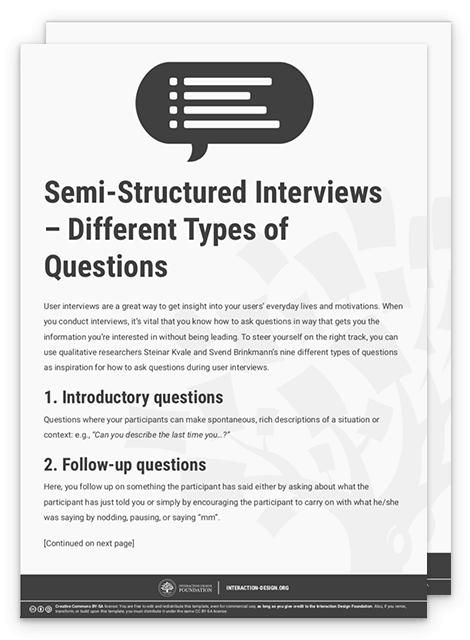
Advance Your Career With This Free Template
for “Semi-Structured Interviews – Different Types of Questions”
Steps to Conduct a Successful Semi-Structured Interview
Proper preparation is key to conducting successful semi-structured interviews. Below are some tips for preparing for your interviews:
Define Your Research Questions: Before conducting interviews, it's important to understand your research questions and objectives clearly. This will help you develop a set of initial questions to guide your interview process.
Develop an Interview Guide: An interview guide is a list of questions and prompts designed to elicit information from participants. It should include open-ended and closed-ended questions and probing questions to encourage participants to elaborate on their responses.
Pilot Test Your Interview Guide: It's important to pilot test your interview guide with a small group of participants before conducting full-scale interviews. This will allow you to identify potential issues or areas where the questions must be revised.
Identify and Recruit Participants: Ensure that your sample is representative of the population you are studying. Consider using targeted sampling methods, such as snowball sampling or maximum variation sampling, to recruit participants who can provide diverse perspectives.
Schedule Interviews: Once you've identified and recruited participants, it's time to schedule interviews. Be sure to allow adequate time between interviews for transcription and analysis.
Conduct Interviews: During the interview process, it's important to establish rapport with participants and create a comfortable environment where they feel safe sharing their experiences and opinions. Be sure to follow your interview guide while allowing flexibility in response to unexpected information during the discussion.
Provide Compensation or Incentives to Participants: Consider offering compensation or incentives to participants to encourage their participation. Compensation can come in many forms, such as gift cards, cash, or vouchers. It can also be non-monetary, such as offering participants the opportunity to receive a summary of the study's findings or the chance to participate in future research projects. Compensation or incentives can help to show participants that their time and contributions are valued and appreciated.
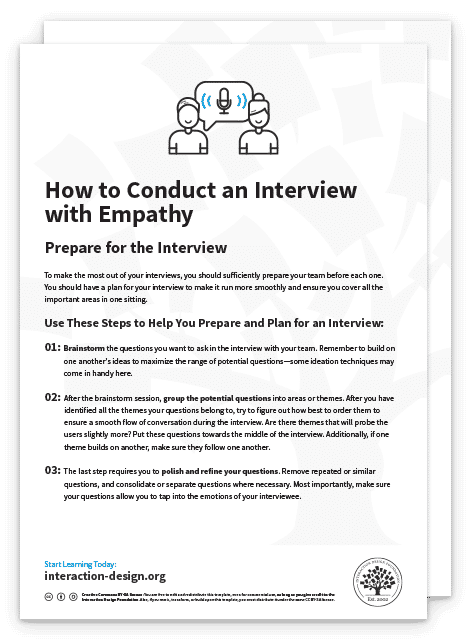
Plan your research with this helpful checklist. Then, get ready to conduct semi-structured interviews! Download this template for help in creating different types of interview questions.
Advance Your Career With This Free Template
for “How to Conduct an Interview with Empathy”
Questions About Semi-Structured Interviews? We've Got Answers!
Why do user researchers prefer semi-structured interviews?
User researchers prefer semi-structured interviews because they balance consistency with flexibility. Unlike structured interviews, which follow a strict script, semi-structured formats allow researchers to guide the conversation while adapting to each participant’s responses. Non-structured interviews might flow too freely and allow users to drift into tangents. Meanwhile, a semi-structured approach uncovers deeper insights into user behaviors, motivations, and pain points.
Semi-structured interviews use open-ended questions to prompt rich storytelling. Researchers can then probe further according to what users reveal. This flexibility leads to discoveries that rigid approaches often miss. For example, when exploring how users interact with a health app, a semi-structured format might uncover emotional drivers behind tracking habits—not just usability issues. Researchers value this approach because it can surface context-specific, qualitative data that shapes user-centered designs.
Explore qualitative research to understand the rich variety of techniques that can yield rich insights from users.
When should I use a semi-structured interview in the UX process?
Use a semi-structured interview during the discovery and early design phases. This is when you need to explore user needs, behaviors, and motivations in depth—especially when you don’t yet know what to ask precisely. Semi-structured interviews help you uncover insights that inform personas, user journeys, and product direction.
They work best when you want to balance consistency (asking all participants similar questions) with adaptability (probing unexpected responses). For example, if you’re designing a budgeting app, a semi-structured interview can reveal how users emotionally relate to money, not just how they track expenses.
How do I plan a semi-structured interview for a UX project?
Begin by defining your research goal. What do you want to learn—user behaviors, motivations, pain points? Next, create a guide with open-ended questions grouped by topic. These serve as anchors to ensure consistency while allowing flexibility.
Design your questions to encourage storytelling. You ideally want to set the scene by asking participants to think back to the last time they did the things you are interested in finding out about. For example, instead of asking “Do you use a budgeting app?” ask, “Can you walk me through how you manage your finances day-to-day?” Include follow-up prompts like “Why?” or “What happened next?” to dig deeper. Also, the setting for the interview should support this wherever possible.
Choose participants who reflect your target users and schedule 30–60-minute sessions. Test your guide with a dry run so you can see where to refine questions and flow. Record sessions only with the consent of the users.
How do I write effective open-ended questions for a semi-structured interview?
To write effective open-ended questions for a semi-structured interview, focus on prompts that encourage users to share stories, not just answers. Start with phrases such as “Can you describe…”, “Tell me about…”, or “What was it like when…”. These invite reflection and reveal context.
Don’t use “yes/no” or leading questions—so, instead of “Do you like this feature?”, ask: “How do you use this feature in your daily routine?” Effective questions dig into motivations, emotions, and experiences. Group them around themes—like habits, challenges, or expectations—and use follow-ups like “Why was that important to you?” or “What happened next?” to go deeper.
Write neutrally, don’t use jargon, and test questions in a pilot interview to refine tone and clarity.
Discover important insights about how to write effective questions for user interviews.
How do I encourage users to talk openly and honestly?
To encourage users to talk openly and honestly in a UX interview, create a safe, respectful environment from the start. Start with some small talk to build rapport and then explain the purpose of the interview and assure users there are no right or wrong answers. Make clear that their feedback will shape better design—not judge them.
Use a calm, neutral tone and active listening techniques (nods, affirmations, and reflective questions) to show genuine interest. Don’t interrupt or react with surprise, especially to negative comments—even quiet sighs or “wow” expressions from you can skew results. Let silence work; users often reveal deeper insights after a pause.
Frame questions to invite stories, not opinions, and be patient. Trust grows when users feel heard, respected, and free from judgment.
Explore valuable aspects of how to approach interview situations in this video with Ann Blandford: Professor of Human-Computer Interaction at University College London.
Transcript
Transcript loading ...
How do I handle unexpected or off-topic answers during the interview?
Stay curious when users give unexpected or off-topic answers during a semi-structured interview. These detours often expose hidden needs or assumptions that scripted questions may miss. Listen fully and assess whether this new direction offers user experience insight.
If so, explore it with follow-up questions like “Can you tell me more about that?” If not, gently steer the conversation back. Use a soft transition like, “That’s really interesting. I’d love to come back to it later, but can we return to how you use the app in the morning?”
Keep your tone respectful and flexible. The best interviews feel like conversations, not interrogations, and some of the richest insights come from the unexpected.
Gain important insights into how rapport helps shape effective interviews, in this video with Ann Blandford, Professor of Human-Computer Interaction at UCL.
Transcript
Transcript loading ...
How do I analyze the data from semi-structured interviews?
If you’ve recorded the interviews (with participants’ consent), begin by transcribing the conversations. This can be done automatically through various specialist services or AI. Then, read the transcripts to identify patterns, themes, and recurring user behaviors or emotions. Use affinity mapping or thematic coding to group similar insights—for example, frustrations with onboarding, motivations behind daily use, or unmet needs.
Tag quotes with labels like “goal,” “pain point,” or “workaround” to organize your findings. Prioritize insights based on frequency, emotional intensity, or relevance to your design goals. Look for contradictions or surprises—they often lead to the most valuable innovations.
Summarize the key themes in user journey maps, personas, or problem statements to inform your next design steps.
How do I validate findings from semi-structured interviews?
Use triangulation; cross-check insights with data from other sources. Combine interview themes with observations, surveys, analytics, or usability tests. You've gained stronger evidence if multiple methods point to the same user need or pain point.
Look for consistency across participants. If several users express similar concerns or behaviors, the insight likely reflects a broader trend. For example, if many users say they avoid a feature because it confuses them, that’s a clear signal to act.
Share findings with teammates or stakeholders for feedback, as they may spot gaps or offer new perspectives. Validation helps transform raw insights into reliable design decisions.
Try triangulation to understand its tremendous potential in design. In this video, with William Hudson, User Experience Strategist and Founder of Syntagm Ltd.
Transcript
Transcript loading ...
How do I adapt semi-structured interviews for different user types or cultures?
To adapt semi-structured interviews for different user types or cultures, tailor your language, tone, and questions with sensitivity. Local researchers are particularly valuable here, as they could either help with the interviews or review some of the questions and topics to be discussed. It’s particularly important where the primary researcher isn’t a native speaker of the participant’s language.
It’s important to use culturally appropriate phrasing; what feels conversational in one culture may seem intrusive or overly casual in another. Avoid jargon or assumptions about technology use, routines, or values.
When interviewing across cultures, start with extra rapport-building and explain the purpose clearly.Adjust examples to match users’ experiences—what works for a tech-savvy urban user may confuse someone in a rural setting. Some cultures value storytelling, while others prefer directness, so observe cues and match the user’s communication style.
Consider translation needs and local norms around privacy or hierarchy, too. Culturally adapted interviews yield more honest, relevant insights.
Climb aboard cultural considerations for design endeavors, in this video with Alan Dix: Author of the bestselling book “Human-Computer Interaction” and Director of the Computational Foundry at Swansea University.
Copyright
Copyright holder: Tommi Vainikainen _ Appearance time: 2:56 - 3:03 Copyright license and terms: Public domain, via Wikimedia Commons
Copyright holder: Maik Meid _ Appearance time: 2:56 - 3:03 Copyright license and terms: CC BY 2.0, via Wikimedia Commons _ Link: https://commons.wikimedia.org/wiki/File:Norge_93.jpg
Copyright holder: Paju _ Appearance time: 2:56 - 3:03 Copyright license and terms: CC BY-SA 3.0, via Wikimedia Commons _ Link: https://commons.wikimedia.org/wiki/File:Kaivokselan_kaivokset_kyltti.jpg
Copyright holder: Tiia Monto _ Appearance time: 2:56 - 3:03 Copyright license and terms: CC BY-SA 3.0, via Wikimedia Commons _ Link: https://commons.wikimedia.org/wiki/File:Turku_-_harbour_sign.jpg
Transcript
Transcript loading ...
How many users should I interview for reliable insights?
Interview 5 to 10 users to gather reliable insights in semi-structured interviews, as this range often uncovers 80%–90% of core themes and pain points. The exact number depends on your user base’s diversity—more variation (for example, in age, roles, or cultures) may require more interviews to surface patterns across segments.
Focus on depth over volume. Semi-structured interviews produce rich, qualitative data, so fewer well-conducted sessions can reveal more than dozens of shallow ones. After 5 interviews, review your notes: Are you noticing recurring themes? If not, continue until patterns emerge.
Balance insight quality with research scope. Your goal isn’t statistical certainty, but enough consistency to design confidently and exceed the reasonable expectations you’ve learnt more about.
This practical guide clearly outlines semi‑structured interviews as a balanced method combining prepared questions with conversational flexibility—a format especially useful in UX research and usability testing. It walks through creating interview guides, obtaining consent, asking follow‑up queries, thematic coding, and triangulating findings. The post highlights benefits—such as richer user insights, contextual depth, and adaptability—and drawbacks like potential bias and analysis time. UX designers will find the step‑by‑step examples (e.g., “tell me why this felt confusing?”) and clear procedures particularly useful for structuring effective interviews and translating qualitative feedback into actionable design insights.
This article defines semi‑structured interviews as a flexible yet organized research method—mixing planned open‑ended questions and on‑the‑fly follow-ups. It covers question design, recommended 30–60‑minute length, use of verbal and nonverbal cues, and analysis techniques like thematic sorting. The post clearly contrasts this approach with structured and unstructured interviews, emphasizing its strengths in depth, rapport-building, and contextual insight valuable for iterative UX work. With concrete guidance and real-use examples, it supports UX designers in implementing robust interview plans that uncover user motivations and attitudes throughout product discovery, testing, and ongoing research workflows.
This book is a comprehensive guide to conducting semi-structured interviews, particularly valuable for researchers in social sciences and design fields like UX. Galletta and Cross integrate theoretical grounding with practical tools for designing, executing, and analyzing interviews. The authors emphasize reflexivity and adaptability, key aspects of effective qualitative research, and provide a longitudinal case study to illustrate application. This work is influential for teaching interview methodology, supporting novice and experienced researchers. Its structured yet flexible approach helps UX practitioners balance exploration and consistency when gathering user insights, making it a staple in both academic and professional qualitative research toolkits.
Earn a Gift! Answer a Short Quiz at the End of This Page
Earn a Gift, Answer a Short Quiz!
1
2
3
4
1
2
3
4
Question 1
Question 2
Question 3
Get Your Gift
2
3
4
2
3
4
Question 1
Question 2
Question 3
Get Your Gift
3
4
3
4
Question 1
Question 2
Question 3
Get Your Gift
4
4
Question 1
Question 2
Question 3
Get Your Gift
Try Again! IxDF Cheers for You!
0 out of 3 questions answered correctly
Remember, the more you learn about design, the more you make yourself valuable.
Why? Because design skills make you valuable. In any job. Any industry.
In This Course, You'll
Get excited as you learn thebusiness superpower: user research! Master it, and you'll solve meaningful problems, create better experiences, and drive success in any field. Why? User research empowers you to become a detective of human behavior. You'll discover what people truly need so that you can create products and services they love. You can use user research to reduce abandoned carts in online shopping, improve patient outcomes in healthcare, and solve challenges in any industry. It's easier than you think! With step-by-step guidance, you'll master User Research quickly—no matter your background. Studies show that user research can improve time to market by up to 330% and increase revenue by up to 320%. So get on board, do work you're proud of, and get paid what you're worth.
Make yourself invaluable with timeless human-centered skills. At the heart of great design is understanding people: What they need, what holds them back, and what keeps them coming back. As AI becomes part of how teams build and iterate, this deep understanding of people turns AI from a tool into your superpower. Effortlessly transform insights into Return on Investment (ROI) as you design solutions people love. You'll learn to make data-driven decisions that eliminate guesswork as you design products and services based on real user needs. That drives loyalty and outperforms competitors. You'll easily translate research into visuals that win over stakeholders, managers, and clients. Discover exactly what motivates people and build solutions that consistently deliver results.
Gain confidence and credibility with hands-on experience in usability testing, contextual inquiries, semi-structured qualitative interviews, and observational methods. Master how to ask the right questions and create actionable personas from your research. You'll plan, conduct, and analyze research in real-world scenarios, fast-tracking your success with 40+ ready-to-use templates like interview guides, affinity diagrams, and customer journey maps. If you want to leave assumptions behind and create with precision, purpose, and impact, this course is perfect for you. If you're interested, we'll even help you build your portfolio around an app, so your new superpowers shine clearly.
It's Easy to Fast-Track Your Career with the World's Best Experts
Master complex skills effortlessly with proven best practices and toolkits directly from the world's top design experts. Meet your experts for this course:
Frank Spillers: Service Designer and Founder and CEO of Experience Dynamics.
Ann Blandford: Professor of Human-Computer Interaction at University College London.
Alan Dix: Author of the bestselling book “Human-Computer Interaction” and Director of the Computational Foundry at Swansea University.
Get an Industry-Recognized IxDF Course Certificate
Increase your credibility, salary potential and job opportunities by showing credible evidence of your skills.
IxDF Course Certificates set the industry gold standard. Add them to your LinkedIn profile, resumé, and job applications.
Be in distinguished company, alongside industry leaders who train their teams with the IxDF and trust IxDF Course Certificates.
All Free IxDF Articles on Semi-Structured Interviews
You have had a green light from your stakeholders to conduct some user research for your design project, and you think user interviews might be the way to go. After all, they seem straightforward, and interviews are one of the most widely used user research methods — so, they should be a safe choice
Carrying out user interviews can be chaotic! You must handle a lot of things at once to ensure that your participants are comfortable and that you get valid results. You must listen to what your participant is saying while also keeping track of where to go next, which questions you haven’t asked yet
You have been in the field talking to users and you now find yourself with a massive amount of audio, notes, video, pictures, and interesting impressions. All that information can be overwhelming, and it’s difficult to know where to start to make sense of all the data. Here, we will teach you how to
Social shares
1.3k
Published
Read Article
Pros and Cons of Conducting User Interviews
You have had a green light from your stakeholders to conduct some user research for your design project, and you think user interviews might be the way to go. After all, they seem straightforward, and interviews are one of the most widely used user research methods — so, they should be a safe choice. But, as with all research methods, there are pros and cons of using user interviews to gain insights for your design project, so knowing how to use interviews correctly is nothing short of vital. Here, you will learn in what situations user interviews are appropriate and insightful, and when you are better off choosing another research method.
What Are User Interviews?
Interviews can be a great way to empathize with your users because interviews can give you an in-depth understanding of the users’ values, perceptions, and experiences. They allow you to ask specific questions, while remaining open to exploring your participants’ points of view. They are also often combined with other user research methods, such as usability tests or surveys, so as to gain deeper insights into objective results by asking a user about them and to elicit the user’s subjective opinion on products or interactions.
We are aware of interviews from many different contexts, from magazines to job interviews, but the term “user interviews” often refers to semi-structured qualitative interviews, which is a research method with roots in the social sciences. As the term implies, semi-structured interviews are somewhat structured in that you prepare a set of topics you would like to cover during the interview, but still open enough that you can follow leads in the conversation and change the order of topics.
In this video, professor of Human-Computer Interaction at University College London and expert in qualitative user studies Ann Blandford describes what characterizes a semi-structured interview.
Transcript
Transcript loading ...
When you conduct semi-structured interviews, you have an interview guide with the questions or themes that you want to talk to the user about, but you are free to change the order of questions or to explore different topics that may arise during the interview. The advantage of the semi-structured interview approach is that you can define a predetermined set of topics that you know to be relevant to your project before you conduct the interview, but you can also explore topics that you had not previously thought relevant. This makes the method especially suitable for creating insights in design projects — because design projects are not usually completely exploratory; instead, they aim to find solutions to specific problems or challenges.
In many ways, an interview is like an everyday conversation, but it’s important to be aware that a good interview requires consideration and structure.
If you google “user interviews,” you might encounter blogs and other web resources which state that interviews are an easy way to create insights for your design project because conducting an interview is like having a conversation with your users — and that doesn’t require a lot of preparation. While interviews obviously share similarities with everyday conversations, a good interview requires preparation and careful consideration on the part of the interviewer. Steve Portigal, founder of Portigal Consulting and author of the book Interviewing Users, states that while interviews superficially resemble more informal social occasions (you meet someone at their home, they offer you coffee, you comment on the weather, etc.), it’s important to be aware of how to ask questions and how to listen in order to gain valid insights into your participant’s life and experiences:
“To learn something new requires interviewing, not just chatting. Poor interviews produce inaccurate information that can take your business in the wrong direction. Interviewing is a skill that at times can be fundamentally different than what you do normally in conversation. Great interviewers leverage their natural style of interacting with people but make deliberate, specific choices about what to say, when to say it, how to say it, and when to say nothing. Doing this well is hard and takes years of practice.”
— Steve Portigal, author of Interviewing Users
So, interviewing is a skill, but it’s a skill that can be learned, and the first step involves knowing when to use interviews and when not to use them.
Pros and Cons of User Interviews
“What users say and what they do are different.”
— Jakob Nielsen, Usability Expert and co-founder of Nielsen Norman Group
User interviews can be very informative and helpful, but only if they are used correctly and for the right things. It’s important to know what you can expect to get out of interviews and what you shouldn’t expect to get out of interviews.
In this video, Ann Blandford explains what you can get out of semi-structured interviews and what you shouldn’t expect to be able to do.
Transcript
Transcript loading ...
When to Conduct User Interviews
User interviews are used both on their own and in combination with other qualitative and quantitative research methods. So, knowing how to conduct interviews will also help you with many other types of research. It also means that how you use interviews in user research and for what purpose varies widely. Let’s look at some of the most common uses for interviews in user research.
For Exploration
User interviews are often conducted during the exploration phase of a design project, before a clear concept has been defined or before a major redesign. You can perform user interviews at the beginning of a project in order to obtain a better understanding of your potential users and various aspects of their everyday lives that are of interest to your project. Context is usually important in order to understand different use cases, because it enables people to “show” what they mean and because it moves an interview to the users’ domain. Consequently, these types of user interviews are often performed in the context where a concept is intended to be used (e.g., in the user’s home, place of work, etc.). When done in the exploration phase of a project, user interviews can form the knowledge basis for personas, scenarios and the like — depending on how you choose to analyze and report on your research. User interviews can also form the knowledge basis for further user research — e.g., to find out what questions are most relevant in a larger survey study.
User Interviews are often used during the exploration phase of a project in order to explore unknown use contexts and use cases.
In Combination with Usability Testing and Formal Experiments
In controlled experiments and usability tests, you will often measure predefined quantitative criteria such as how many errors the user performs or how long it takes to complete a task. It’s also common to evaluate the user’s experience using questionnaires with a rating scale — e.g., “Please rate how easy it was to locate feature X on a scale from 1-5.” When you use objective criteria and questionnaire ratings, you’ll find them to be straightforward ways to collate your data, allowing you to perform different statistical analyses. However, predetermined measures don’t allow for more exploratory analyses of the user’s experience; so, formal experiments or usability tests are sometimes finished with a follow-up interview.
Here, it’s common to ask the user questions that make it possible to understand the reason behind the user’s actions and experience. The users can explain why they liked or disliked certain features, and you can also ask them to explain why they performed unexpected actions. User interviews are mostly used during studies involving a limited number of participants, such as classic usability testing, and more rarely in large-scale experiments involving a lot of participants.
Interviews are sometimes used in combination with usability tests and formal experiments in order to gain qualitative insights into the user’s experience.
Another common use for user interviews is to explore concept ideas during the early stages of the development process. One way to do this is to show users illustrations or early models of the concept idea so as to obtain their feedback. Concept exploration interviews provide valuable input, but they can be difficult to perform without influencing the participant. Participants are normally eager to please and might be overly positive about your ideas if you are not careful. You should stick to asking users about the problems and desires they have in relation to your problem space, but try to avoid asking them to evaluate specific solutions.
Another way to conduct interviews for concept exploration is to perform interview in which you ask about the areas relevant to your concept idea, without revealing the nature of your concept. For example, let’s say you are working on a home banking system and you have some ideas as to how to help your users get a better overview of their monthly budget. Rather than present the idea to your users, you would interview them to explore how/if they currently budget and what options they would like to see in the future. Conducting concept interviews in this way will allow you to collect valuable information to inform your concept without asking the participants directly what they think about your ideas. You can also combine the two methods by presenting your ideas during the last part of the interview.
In Combination with Observations
Observations of the users’ actions and context are often combined with interviews. The advantage of conducting interviews in context is that users can show you how they do something. It can be difficult for users to tell you how they use products or perform everyday activities, because they may not remember or they don’t know. If you are interested in how users do something, you are better off watching what they do and then interviewing them about anything that was unclear. There are different ways of doing this. In contextual inquiry, interview and observation are completely integrated. You ask the participant questions at the same time as you observe them interact with a product or perform a daily activity. The user is also asked to explain their interaction as though explaining it to a novice user. In other situations, you do the observation first and refrain from asking the participant any questions until afterwards — to avoid influencing their behavior. If you are performing video observations, you can also get great insights from showing the recordings to your participants and interviewing them about it.
The Take Away
When done correctly, user interviews can provide valuable insights into what the world looks like from your users’ perspectives, but you need to know how to use them and when to use them. It’s important to realize that an interview is different from a normal conversation and you should be careful not to ask your participants questions that they don’t know the answer to. Interviews can be used on their own and in combination with many other types of user research, making them one of the most widely used qualitative user research methods.
AI is replacing jobs everywhere, yet design jobs are booming with a projected 45% job growth.
With design skills, you can create products and services people love. More love means more impact and greater salary potential.
At IxDF, we help you from your first course to your next job, all in one place.