Linear thinking—or vertical thinking—is the traditional mode of ideation that designers problem-solve with by using logic, past data and existing solutions. They typically apply it when using convergent thinking methods to analyze the ideas they generate during divergent thinking sessions and see which might work best.
See what linear thinking means in terms of problem-solving.
“If I had an hour to solve a problem, I'd spend 55 minutes thinking about the problem and 5 minutes thinking about solutions.”
— Albert Einstein
Linear Thinking = Everyday Thinking
Linear thinking is vital for making sense of a world which otherwise would be impossible to manage. Its ordered structure means we can be rational, have confidence in predictable outcomes and use the following to tackle problems:
Logic – “For problem A, apply solution B to get result C.”
Past Data – “This looks like something we’ve seen before and addressed in manner X.”
Existing Solutions – “Brand Y have a tool (Z) for doing that; let’s adapt our own version of it.”
However, in user experience design, the challenge is to identify problems before you can understand them fully. Only then can you begin to hunt for possible solutions. The problem with starting with a linear/vertical approach to design problems—especially more complex ones—is you’ll:
Commit to a set starting point – which may well be the wrong one, and you might jump to a problem statement without considering other angles: E.g., “Users of voice-controlled devices need a privacy feature for phone calls, since they fear being spied on by listening devices.”
Limit the number of possible solutions – by constraining yourself to a single starting point and line of reasoning: E.g., “Let’s design an app that can jam/block any listening device’s sensors within a 40-foot radius while a user makes a phone call.”
Finish with sub-optimal solutions – when you misdirect your problem-solving efforts, you’ll likely arrive at solutions that may seem desirable (to users), viable (which brands can support and sustain) and feasible (technologically possible) but which actually miss the point of the true problem and may create other difficulties: E.g., Your app gets banned due to signal interference issues.
In our example, we quickly identified listening devices as being the cause to address. Doing so, though, we shut off other avenues to explore: e.g., signal-detecting technology that could alert users to the type, number and distance of devices that might overhear them. Therefore, while the strength of an analytical, logical way of thinking helps us transition clearly from point to point, the reality is it’s more like a narrow funnel that pours into a tiny box of possibilities. With so limited a scope of aspects to address, you can easily drop down to possible solutions – but they’ll likely be flawed or sub-optimal.
© Yu Siang and Interaction Design Foundation, CC BY-SA 3.0
When and How Linear Thinking Works Best
Linear thinking is still essential for you and your team – timing is key. Unless your problem is remarkably straightforward, it’s best to use linear thinking later in ideation sessions, after you’ve thoroughly explored everything on the horizon of the frontier of true creativity. The design thinking process accounts for this nicely, but here’s an overview of how to include linear thinking:
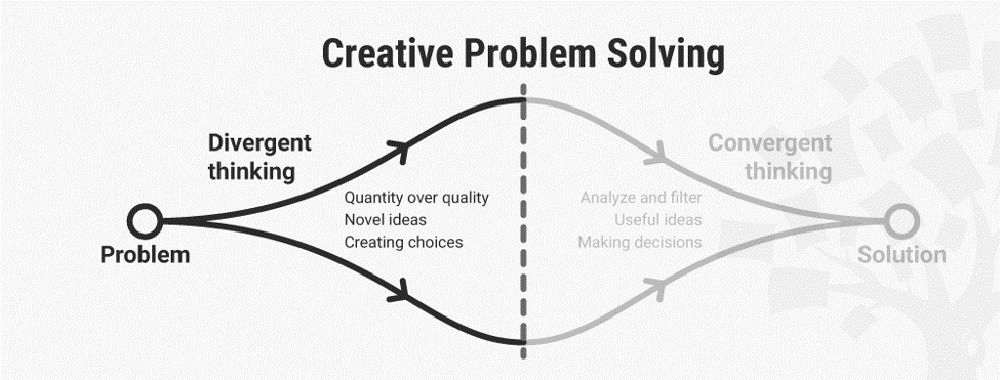
Get disruptive to maximize your views of a situation and explore all possible angles and options through these closely related ideation modes and the methods they involve:
Divergent thinking – Go for quantity over quality, novel ideas and creating choices.
Lateral thinking – Focus on overlooked aspects, challenge assumptions and find alternatives.
Outside-the-box thinking – Understand what’s limiting you and why, find new strategies to approach the problem and explore the edges of the design space.
Arrive at a place where you can reframe the problem and see the many factors affecting the situation, your users, other actors, etc., in a new light. This happens after you’ve harvested vast quantities of ideas through methods such as brainstorming. You have your novel ideas; it’s time to leverage convergent thinking to:
Sort these.
Group them into themes.
Find common threads.
Decide on winners and losers.
And use methods (e.g., embrace opposites, multiple classifications) to isolate ideas that are novel and useful.
Thinking linearly here doesn’t mean you stop being creative and hand over decision-making to pure logic. Instead, you stay mindful of opportunities as you:
Look past logical norms (e.g., when you notice yourself thinking “This solution won’t work because the world doesn’t work that way.” and reconsider the idea.)
See how an idea stands in relation to the problem. (E.g., “A jamming app will treat one symptom of voice-controlled device spying.”)
Understand the reality/dimensions of that problem. (E.g., “The user’s location, which can change relatively easily, should be the focus.”)
Determine the best criteria to judge the idea with. (E.g., “What would we be demanding of the phone user to do versus what inconveniences would be imposed on others nearby?”)
Ultimately, for fleshing out good ideas to adapt into testable prototypes, linear thinking lets you build and fine-tune. Then, you’ll increase your chances of finding the most desirable, viable and feasible solution for your users, which may be innovative enough to secure your brand its place in a lucrative market gap.