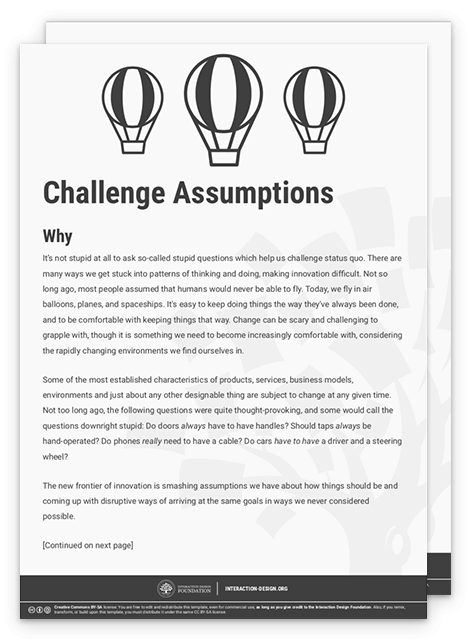
“Challenge assumptions” is an ideation method that helps UX (user experience) design teams break free from conventional thinking and push past false beliefs. You use it to identify and question the assumptions your design decisions rest on, then flip or remove them to uncover fresh solutions. It’s a powerful way to spark innovation and shift how you see a problem.
In this video, William Hudson: User Experience Strategist and Founder of Syntagm Ltd., explains how design thinking helps you challenge assumptions to redefine problems and generate innovative solutions.
Why Designers Challenge Assumptions
Consider where design would be if nobody had dared to push past the assumption that users “needed” physical keypads on handheld devices. Or, on a slightly different note, how about the famous story of the truck that became wedged under a bridge? In this well-known anecdote, the problem stumped experts who suggested complex solutions, until a child reportedly proposed simply letting air out of the tires. Whether or not the story is true, it illustrates how stepping outside assumptions can reveal simple, overlooked solutions. Sometimes it takes the distance of perspective to afford users (or trapped truck drivers) the freedom to move forward. A key part? Getting past assumptions and not-so-accurate grasps of reality that might otherwise hold you back.
The method, “challenge assumptions,” helps you find essential truths about what users really want. It can also show you how you can fly high above design conventions that seem “the only way to do it,” even if they revolve around incorrect viewpoints of what’s really going on. Assumptions about users, for example, can pose one of the most hazardous threats to effective design.
What makes assumptions so risky? They often lurk in plain sight, too close to a designer’s way of envisioning a situation (and the people in it) to stand out as potentially flawed beliefs. For example, consider the “more is better” assumption regarding features for an app. Power users may appreciate the extra control from an overdose of functionality, but most users won’t, feeling overwhelmed, and the app’s usability will suffer.
Not all assumptions are “bad”; it’s just that their validity needs testing rather than designers clinging to them with blind faith. When you use this structured ideation technique, it helps your team rethink the boundaries of a problem by questioning the beliefs and constraints you treat as givens. You list those assumptions, flip them with “what if” and “why” questions, and then use the results to spark original, disruptive ideas. Challenging assumptions works well in the ideation phase in design thinking and other user-centered processes because many of the constraints we follow aren’t real; they’re just habits of thought.
How to Challenge Assumptions: A Step-by-Step Approach
Take the following steps to weed out assumptions you and your team may have and challenge them head-on:
Step 1: Identify Assumptions
Gather your team and write down every assumption you’re making about the product, user, market, or technology. Think broadly about these questions:
“What do we assume users want or need?”
“What do we assume is technically required?”
“What do we assume about user behavior?”
“What rules are we following without questioning?”
Common assumptions include things like these: “The homepage must have a navigation bar,” or “Users won’t scroll beyond the fold.” These often sound like facts, but they’re not; they’re design habits. Although you may find some truth in assumptions (and convention may seem to “dictate” some design norms), it’s imperative to take nothing for granted, get them out in the open, and make them prove their validity.
Step 2: Challenge Each One
Now go through the list and flip each assumption. Ask bold, brave, and provocative questions like:
“What if the opposite were true?”
“Why do we think this is required?”
“What would happen if we removed this entirely?”
“Could we do this in a completely different way?”
The goal isn’t just to poke holes, but to reframe the challenge. For example, if your assumption is “Users must log in to see their dashboard,” challenge it by asking: “What if users didn’t have to log in at all? What if the dashboard wasn’t the default starting point?” Some team members may express doubt at some questions (or even seem amazed at the “audacity” of asking them), but therein lies the strength of challenging assumptions (and the danger of not challenging them).
Step 3: Turn Reframed Assumptions into Design Prompts
Once you’ve challenged several assumptions, use them as springboards for ideation. Each flipped assumption can become a new opportunity to reach a fresh design solution that might work wonders for users:
“What would a dashboard-less experience look like?”
“What if the interface adapted based on time of day?”
“What if users didn’t need to type anything to get started?”
Take these prompts and brainstorm freely so you can “run away” with them. Use sketching, storyboarding, or mind maps to explore the new space.
In this video, William Hudson shows you how to run judgment-free brainstorming, using quick sketches and mind maps to spark bold ideas.
Step 4: Prioritize, Prototype, and Test
From your ideas, choose a few that feel promising and feasible. Create quick prototypes (low-fidelity paper prototypes, for example) or sketch user flows. Then test these with users, or at least discuss them with cross-functional teams to see how viable they are.
In this video, Alan Dix, Author of the bestselling book “Human-Computer Interaction” and Director of the Computational Foundry at Swansea University, shows you how to turn promising ideas into quick prototypes, test them with users, and iterate toward a good-enough solution.
Step 5: Reflect and Capture Learning
After the session, document what you learned. Which assumptions proved invalid? Which ones proved useful to question? Make a note of these so that your team can revisit them in future sessions.
Best Practices and Tips for Better Assumption Challenging
As you start getting to grips with assumptions and proceed through the above steps:
Realize that some constraints are real for a reason. While outdated beliefs comprise many constraints, some all-too-real legal, regulatory, or safety requirements might limit your options. Be careful to distinguish the two; when in doubt, ask “Who says this has to be true?”
In this video, William Hudson explains how identifying true constraints early, including regulatory and technical requirements, helps you distinguish unavoidable limits from inherited assumptions so you can design within what is genuinely possible.
Make the most of team diversity for richer sessions. Hear from everyone, including development, product, support, and marketing people. Each function holds different assumptions about what’s possible or valuable, and each viewpoint might spot assumptions you mightn’t notice you have.
Timebox the exercise. Don’t let it drag; set timers for each phase, such as 15 minutes to list, 15 to challenge, and 20 to ideate.
Encourage “stupid” questions. Many breakthroughs come from asking what seems self-evident to everyone. That’s where the real assumptions lie, so take the initiative to push past the givens and be that “Advocate of the Obvious.” The team members who think “But everyone knows that’s a fact!” may soon become contributors who say, “Wow! I’d never thought of it like that! So, does that mean we might try something like…?”
Visualize everything. Use whiteboards, sticky notes, or virtual tools, since seeing the connections helps generate more ideas.
Follow up with action. Don’t let the ideas sit on a whiteboard. Convert a few into prototypes or user test concepts as soon as possible.
Use it regularly. This isn’t just for stuck teams, as a kind of medicine to aid mental constipation. Use it in kickoffs, retros, and midway checkpoints to keep your thinking sharp and your team members more aware.
The Benefits of Challenging Assumptions
When you systematically question assumptions in your design process, you unlock several key advantages, namely:
More Innovative Ideas
You stop circling familiar solutions and open the door to radically different concepts, ones that wouldn’t emerge under your original constraints.
Better Alignment with Users
You are not your users, as much as you might believe you’re fully aligned with how they see their world. And when you challenge what you think you know about users, you create space for more accurate, research-informed solutions. This often leads to designing experiences that users find more relevant, inclusive, and useful, and proves your empathy for them.
Explore how empathic design turns stressful airport moments into calm, inclusive experiences by prioritizing what users actually need, in this video.
Reduced Risk
By surfacing and testing assumptions early, you avoid sinking time and resources into products you and your team might build on shaky foundations. Many wrong ideas about user behavior, user needs, platform requirements, business rules, or technical feasibility have a nasty tendency to “hide” as you research or discuss insights with your team. If assumptions go unquestioned, they can limit the ideas a team is willing to consider. Worse, if an incorrect assumption makes it into the final design, it might spell disaster for the product.
Greater Creativity across Disciplines
The challenge assumptions technique encourages everyone, from designers to business stakeholders and beyond, to think more openly. It levels the playing field and fosters a more collaborative, creative culture, handy especially when cognitive biases can keep many team members from identifying and busting assumptions they might hold.
In this video, Alan Dix shows how biases like anchoring skew judgment and how changing the frame helps you challenge assumptions and break fixation.
Deeper Team Awareness
When your team examines their thinking habits, they will become more self-aware and less attached to legacy decisions or outdated mental models. This creates a healthier design environment, one where you can spot and look past what might seem to be the one and only “truth.”
Perhaps most importantly, because this method reframes your problem space and gives you permission to question everything, it helps you turn mental roadblocks into launchpads for creativity.
When to Use the Challenge Assumptions Method
The trick is to get the distance and insight to know when you’re stuck in familiar thought patterns or retreading over familiar design territory. More specifically, watch out for these symptoms of “assumptionitis”:
You feel stuck with familiar thought patterns or feel old solutions constraining you.
Your team keeps proposing the same features or flows.
The problem definition feels too narrow or “locked in.” For example, “How can we make our checkout button more noticeable so users complete their purchase?” might seem reasonable. However, what if the real problem is that users don’t trust the site or find the checkout process cumbersome?
You sense that your team is overlooking important user behaviors or needs.
You want to generate more unexpected, original ideas.
You suspect internal constraints (like time, budget, or technical requirements) are too easily accepted and your team has its “hands tied.”
It’s wise to use the challenging assumptions technique after early user research, too, when it’s time to frame how the product might take shape. Then, you’ll likely notice your team is already assuming things about how users should interact with the product or what’s feasible. That’s the perfect moment to slow down and challenge those beliefs, before they become deeply entrenched.
Overall, “challenge assumptions” isn’t just a clever ideation trick; it’s a mindset. It teaches teams to stay curious, question the status quo, and look past surface-level solutions. Even research-based insights can turn into assumptions if nobody tests them continuously. However, note that the goal isn’t to dismiss everything; it’s to examine beliefs critically and decide whether they still serve the project.
In UX design, where habits and heuristics often guide decision-making, “challenge assumptions” acts as a reset button. It forces you to ask: “What are we really designing for, and are we sure our starting point is even true?” Whole paradigms can change with the kind of creative push that empowers your next big idea to start where you certainty ends. In an ever-evolving arena where modern users want effective solutions to address real-world problems amid changing technology and new apps, don’t give assumptions a license to hijack true innovation. With courage, awareness, and insight, when you dare to inquire, you can reach heights where great ideas live and bring them down to street level standing on the solid ground of knowledge and valid insights.