Your constantly-updated definition of Wicked Problems and collection of videos and articles. Be a conversation starter: Share this page and inspire others!
197 Shares
What are Wicked Problems?
Wicked problems are problems with many interdependent factors making them seem impossible to solve. Because the factors are often incomplete, in flux, and difficult to define, solving wicked problems requires a deep understanding of the stakeholders involved, and an innovative approach provided by design thinking. Complex issues such as healthcare and education are examples of wicked problems.
Transcript
Transcript loading ...
The term “wicked problem” was first coined by Horst Rittel, design theorist and professor of design methodology at the Ulm School of Design, Germany. In the paper “Dilemmas in a General Theory of Planning,” he describes ten characteristics of wicked problems:
There is no definitive formula for a wicked problem.
Wicked problems have no stopping rule, as in there’s no way to know your solution is final.
Solutions to wicked problems are not true-or-false; they can only be good-or-bad.
There is no immediate test of a solution to a wicked problem.
Every solution to a wicked problem is a "one-shot operation"; because there is no opportunity to learn by trial-and-error, every attempt counts significantly.
Wicked problems do not have a set number of potential solutions.
Every wicked problem is essentially unique.
Every wicked problem can be considered a symptom of another problem.
There is always more than one explanation for a wicked problem because the explanations vary greatly depending on the individual perspective.
Planners/designers have no right to be wrong and must be fully responsible for their actions.
Design theorist and academic Richard Buchanan connected design thinking to wicked problems in his 1992 paper “Wicked Problems in Design Thinking.” Design thinking’s iterative process is extremely useful in tackling ill-defined or unknown problems—reframing the problem in human-centric ways, creating many ideas in brainstorming sessions, and adopting a hands-on approach in prototyping and testing.
Transcript
Transcript loading ...
Questions About Wicked Problems? We've Got Answers!
Is poverty a wicked problem?
Yes, poverty is a wicked problem.
Transcript
Transcript loading ...
As Don Norman elucidates in this video, wicked problems refer to challenges that are hard to define and address due to their complex nature, much like complex socio-technical systems. Like the example of world peace Norman mentions, poverty possesses multifaceted roots and impacts, making solutions elusive. Tackling such issues doesn't guarantee permanent resolution. However, it's crucial to understand that even if we can't wholly eradicate problems like poverty, continuously striving for improvements and bettering lives is the way forward. While wicked problems persist, consistent advancement in addressing them represents success.
Is climate change a wicked problem?
Indeed, climate change exemplifies a wicked problem. As Don Norman elucidates in this video, the complexities of climate systems, human activity, ecology, and their interconnectedness pose challenges in understanding and addressing the issue.
Transcript
Transcript loading ...
The non-linear nature of these systems, intertwined with feedback loops and feed-forward loops, adds to the intricacy. Moreover, people's simplistic causality models hinder recognizing multifaceted causes and delayed consequences. While many often resist change, especially those benefiting from the status quo, the palpable effects of climate change—fires, floods, famine, and extreme weather events—are now evident worldwide. Although historically, we've been reactive, responding post-calamity, the tangible repercussions of climate change have catalyzed a global response, providing a glimmer of optimism for the future.
Is healthcare a wicked problem?
Yes, healthcare is a wicked problem. Addressing healthcare issues often involves navigating complex, interconnected systems that require multi-faceted approaches. In Don Norman's video, he speaks about incrementalism, where tackling significant challenges is done step by step.
Transcript
Transcript loading ...
Securing funding for incremental steps in healthcare can be challenging; yet, taking massive leaps can lead to inflexibility and risk. Borrowing concepts from software development, Norman presents three strategies that can be applied:
Incrementalism: Address healthcare challenges in small, adaptable steps, ensuring each move is in the right direction.
Minimum Viable Project (MVP): Borrowed from Agile programming, it's about creating small, functional segments of the larger solution. This method ensures that each part, even if small, is working effectively.
Object-Oriented Approach: Here, the focus is on the inputs and outputs of a system, not the internal process. This modular design allows for flexibility and adaptation as healthcare needs and methods evolve.
How to solve a wicked problem?
Transcript
Transcript loading ...
According to HCI expert Alan Dix, understanding the difference between puzzles and real-world problems is crucial. Puzzles have a single correct solution with all the necessary information provided. However, wicked problems inherent to real-world scenarios are not as clearly defined as puzzles. They may not have a definite answer and may even be insoluble in their initial form. The primary step is deeply understanding the problem, as solutions may become evident once fully grasped. Indeed, there's a saying, "If I had an hour to solve a problem, I'd spend 55 minutes thinking about the problem and 5 minutes thinking about solutions." Thus, investing time in understanding, redefining, and negotiating the problem can pave the way to practical solutions. In the realm of wicked problems, creative thinking and individualized approaches are paramount.
What are wicked problems in design thinking?
In design thinking, wicked problems refer to complex challenges that lack clear solutions or boundaries. Unlike puzzles, which have a definitive answer, wicked problems are unique, possess no classic formulation, and their potential solutions are non-enumerable. The complexity arises from the interconnectedness of factors and the inability to use a prior solution for a new problem. These problems often require creative, individualized approaches and deep understanding for effective resolution. As detailed in this article on the history of Design Thinking on interaction-design.org, design thinking as a methodology emphasizes empathy, iteration, and collaboration, making it aptly suited to address wicked problems by redefining and understanding them from various perspectives.
What are examples of wicked problems?
Climate Change: Addressing the causes and impacts of global warming involves balancing the needs of various nations, industries, and populations. Solutions can have unintended consequences, and only some answers satisfy all stakeholders.
Healthcare: Ensuring affordable, high-quality healthcare for all is a complex issue with economics, politics, and individual health needs.
Poverty and Economic Inequality: Addressing the root causes and alleviating the effects of poverty require multifaceted solutions involving education, job creation, health services, and more.
Urban Planning and Housing: Balancing the needs for housing, transportation, green spaces, and commercial areas in rapidly growing urban areas is a constantly evolving challenge.
Global Terrorism: Addressing the root causes and responding to the effects of terrorism involves considerations of international relations, religion, socio-economic factors, and security concerns.
Water Scarcity: Ensuring adequate, clean water for all involves a mix of technological, environmental, political, and social solutions.
Food Security: Ensuring everyone has access to sufficient, safe, and nutritious food involves considerations of agriculture, trade policies, climate change, and socio-economic disparities.
Immigration and Refugees: Managing migration and addressing the needs of refugees requires balancing national security, economic interests, humanitarian concerns, and social integration.
Education Reform: Ensuring quality education for all, adapting to technological changes, and preparing students for a rapidly changing world is a multifaceted challenge.
Biodiversity Loss: Protecting endangered species and habitats in the face of urban development, climate change, and other pressures is a complex, ongoing struggle.
These are just a few examples, and many other problems could qualify as "wicked" given the proper context and scale. The hallmark of wicked problems is that they can't be solved with linear, traditional problem-solving methods and require a more holistic, adaptive, and iterative approach.
What is a wicked problem in leadership?
Wicked problem in leadership refers to challenges that leaders face, which are complex, multifaceted, and often resist straightforward solutions. These problems often arise from various factors, including human behavior, organizational dynamics, external pressures, and evolving circumstances. Addressing such issues requires a leader to navigate ambiguity, adapt to changing contexts, and collaborate with diverse stakeholders. Here are some examples of wicked problems specific to leadership:
Organizational Culture Change: Changing the ingrained culture of an organization is a long-term process filled with resistance, unexpected challenges, and the need for continuous adaptation. A leader might have a vision for a more innovative or inclusive culture, but translating that vision into tangible changes in behavior, systems, and practices is a wicked problem.
Digital Transformation: In an era of rapid technological change, leaders face the wicked problem of ensuring their organizations adapt and innovate while maintaining core functions and managing potential disruptions.
Ethical Dilemmas: Leaders sometimes face decisions without clear, correct answers, and various ethical principles might conflict. These dilemmas involve privacy, data security, team member rights, or corporate social responsibility.
Stakeholder Management: Leaders in complex organizations must manage a web of stakeholders, each with distinct interests, priorities, and expectations. Balancing the needs of employees, shareholders, customers, regulators, and the broader community is a constant challenge.
Crisis Management: Responding to unforeseen crises, be they financial, reputational, or operational, requires leaders to make quick decisions with limited information, all while managing internal and external perceptions.
Are wicked problems good or bad?
Wicked problems are complex challenges that defy straightforward solutions. While they are inherently complex and can be perceived as 'bad' due to their complexity and often represent negative scenarios, they also present opportunities for innovation and deep understanding. Addressing wicked problems often requires a blend of systems thinking and agile approaches. This article on Interaction Design Foundation delves into a 5-step method to tackle wicked problems, combining systems thinking with agile methodology. Therefore, while wicked problems are challenging, they can lead to significant growth and insights when approached effectively.
Where to learn more about wicked problems?
Want to explore wicked problems further? Dive into our 21st Century Design course to uncover modern design challenges and solutions. For a deep dive into design's impact on global issues, explore Design for a Better World. Both courses empower you with tools to navigate wicked problems in design.
Transcript
Transcript loading ...
Earn a Gift! Answer a Short Quiz at the End of This Page
Earn a Gift, Answer a Short Quiz!
1
2
3
4
1
2
3
4
Question 1
Question 2
Question 3
Get Your Gift
2
3
4
2
3
4
Question 1
Question 2
Question 3
Get Your Gift
3
4
3
4
Question 1
Question 2
Question 3
Get Your Gift
4
4
Question 1
Question 2
Question 3
Get Your Gift
Try Again! IxDF Cheers for You!
0 out of 3 questions answered correctly
Remember, the more you learn about design, the more you make yourself valuable.
Improve your UX / UI Design skills and grow your career!
Join IxDF now!
Congratulations! You Did Amazing
3 out of 3 questions answered correctly
You earned your gift with a perfect score! Let us send it to you.
1
Check Your Inbox
We've emailed your gift to name@email.com.
Improve your UX / UI Design skills and grow your career! Join IxDF now!
Learn More About Wicked Problems
Make learning as easy as watching Netflix: Learn more about Wicked Problems by taking the
online IxDF Course Design Thinking: The Ultimate Guide.
Why? Because design skills make you valuable. In any job. Any industry.
In This Course, You'll
Get excited when you discover that you don't need to start from scratch to use the secret recipes that empower companies like Apple and Google to shape the future. You just need a structure and proven methods to optimize what you already do. As AI becomes part of your day-to-day workflows, your ability to guide it with timeless human-centered skills such as strategic thinking, creativity, and empathy for real users is what turns AI into your superpower and delivers meaningful results.
Build on your existing creativity, problem-solving, and people skills to learn the powerful 5-stage method called Design Thinking. It's one of the key drivers behind Apple and Google's continuous innovation and provides a clear, structured way to solve real-world problems. You've already got the instincts, so it's easy to learn the method.
Make yourself invaluable with hands-on skills in Design Thinking. Design Thinking can help you break into User Experience Design, product design, and tech. It's widely applicable, impactful, and fun! Use your skills to improve customer support processes, create new products, and even tackle big challenges like climate change. This human-centered approach is a key driver of business success because it guides you to systematically understand and address what your users really need and want. That's why Design Thinking skills can help you increase sales, keep customers loyal, and turn them into powerful advocates for your company.
Gain confidence and credibility as you effortlessly apply methods from all five stages of the Design Thinking process. You'll be guided to build empathy and gather insights into people's habits through user interviews.
Use our downloadable templates to create affinity diagrams, empathy maps, and actionable "How Might We" questions. Develop solutions as you apply ideation and innovation methods. Create a paper prototype early and fast, then test and optimize your prototype to ensure that your users love it. More love, more impact, greater salary potential.
Apply your new skills in an optional project where you'll design and test a user-centered experience that's perfect for your portfolioand career growth. Master Design Thinking to amplify your uniquely human strengths like empathy, intuition, and creativity, and confidently stay in demand as AI reshapes how teams work.
It's Easy to Fast-Track Your Career with the World's Best Experts
Master complex skills effortlessly with proven best practices and toolkits directly from the world's top design experts. Meet your experts for this course:
Don Norman: Father of User Experience (UX) Design, author of the legendary book “The Design of Everyday Things,” and co-founder of the Nielsen Norman Group.
Alan Dix: Author of the bestselling book “Human-Computer Interaction” and Director of the Computational Foundry at Swansea University.
Mike Rohde: Experience and Interface Designer, author of the bestselling “The Sketchnote Handbook.”
Get an Industry-Recognized IxDF Course Certificate
Increase your credibility, salary potential and job opportunities by showing credible evidence of your skills.
IxDF Course Certificates set the industry gold standard. Add them to your LinkedIn profile, resumé, and job applications.
Be in distinguished company, alongside industry leaders who train their teams with the IxDF and trust IxDF Course Certificates.
What Are Wicked Problems and How Might We Solve Them?
Have you ever come across a problem so complex that you struggled to know where to start? Then you might have stumbled upon a wicked problem. While wicked problems may not have a definite solution, there are certainly things you can do to mitigate any negative effects. When you learn how to tackle w
We need to appreciate the roots and origins of a concept to truly understand it—we need to know how it came to be. Let’s take a look at how design thinking emerged from an exploration of theory and practice to become one of the most effective ways to address the human, technological and strategic in
Social shares
1.3k
Published
Read Article
What Are Wicked Problems and How Might We Solve Them?
Have you ever come across a problem so complex that you struggled to know where to start? Then you might have stumbled upon a wicked problem. While wicked problems may not have a definite solution, there are certainly things you can do to mitigate any negative effects. When you learn how to tackle wicked problems, you learn how to improve the world and the lives of the people who live in it. Here, you’ll learn the ten characteristics of a wicked problem and five steps to tackle wicked problems.
What Is a Wicked Problem?
A wicked problem is a social or cultural problem that’s difficult or impossible to solve because of its complex and interconnected nature. Wicked problems lack clarity in both their aims and solutions, and are subject to real-world constraints that hinder risk-free attempts to find a solution.
Classic examples of wicked problems are these:
Poverty
Climate change
Education
Homelessness
Sustainability
What is the Difference between Puzzles, Problems and Wicked Problems?
Let’s create an overview by first looking into the difference between a puzzle and a problem, and then afterwards we’ll examine wicked problems.
Transcript
Transcript loading ...
Which Wicked Problems Do We Need to Deal with?
Many of the design problems we face are wicked problems, where clarifying the problem is often as big a task as solving it… or perhaps even bigger. Wicked problems are problems with many interdependent factors making them seem impossible to solve as there is no definitive formula for a wicked problem.
A wicked problem is often a social or cultural problem. For example, how would you try to solve global issues such as poverty… or education? What about climate change, and access to clean drinking water? It’s hard to know where to begin, right? That’s because they’re all wicked problems.
What makes them even worse is the way they’re intertwined with one another. If you try to address an element of one problem, you’ll likely cause unexpected consequences in another. No wonder they’re wicked! It’s clear to see that standard problem-solving techniques just aren’t going to cut it when you’ve got a wicked problem on your hands.
You’ll need to gain a much deeper insight into the people involved and learn how to reframe the problem entirely if you want to have any sort of chance at coming up with a valuable solution.
10 Characteristics of a Wicked Problem
As you can see, we need to dig deeper to understand the essence of wicked problems. Horst W.J. Rittel and Melvin M. Webber, professors of design and urban planning at the University of California at Berkeley, first coined the term wicked problem in “Dilemmas in a General Theory of Planning” (1973). In the paper, they detail ten important characteristics that describe a wicked problem:
There is no definitive formula for a wicked problem.
Wicked problems have no stopping rule—there’s no way to know whether your solution is final.
Solutions to wicked problems are not true or false (right or wrong); they can only be good or bad.
You cannot immediately test a solution to a wicked problem.
Every solution to a wicked problem is a “one-shot operation” because there is no opportunity to learn by trial and error—every attempt counts significantly.
Wicked problems do not have a set number of potential solutions.
Every wicked problem is essentially unique.
Every wicked problem can be considered a symptom of another problem.
There is always more than one explanation for a wicked problem because the explanations vary greatly depending on the individual’s perspective.
The planner/designer has no right to be wrong and must be fully responsible for their actions.
We still face the classic wicked problems in today’s world; however, there are further examples we now have to consider. Business strategy, for example, is now often classed as a wicked problem because strategy-related issues normally meet at least five of the characteristics listed above.
From Wicked Problems to Complex Socio-Technical Systems
The rapid technological advancement of the 21st century has, in many ways, mutated wicked problems. In today’s hyperconnected world, it is difficult to look at problems in isolation.
Let’s look at sustainability, for example. Recycling is often considered as one of the solutions to achieve sustainability. Don Norman: Father of User Experience design, author of the legendary book The Design of Everyday Things, co-founder of the Nielsen Norman Group, and former VP of the Advanced Technology Group at Apple, in his two-part essay for FastCompany, examined recycling and remarked: “I am an expert on complex design systems. Even I can’t figure out recycling.”
He describes in detail how difficult it is for people to send their household waste to get recycled. There are different rules for different materials—paper, plastics, glass, metals. And within a category, say, plastic, there are different rules for different types of plastic in different places. Not all plastics can be recycled. Those that can be recycled, demand specialized equipment and processes that are not universally available.
“Recycling is a poor solution to the wrong problem.”
— Don Norman
The complexity of recycling is a problem. But why do we need to recycle at all?
It's because most of the products we use in our lives are made from non-reusable materials. Consider smartphones—most, if not all, have batteries that cannot be separated from the device. If your battery no longer functions as intended, you must replace it with a new phone.
What if the iPhone had a removable battery, which could be fixed or replaced so that you didn’t have to throw out the entire phone, if (when) the battery died? What if phones weren’t built to crack or become obsolete within a short time?
What if companies considered alternate materials to manufacture phones, or government legislation made it mandatory for companies to take back all their material, and put them back into the manufacturing process? The piles of garbage on the planet are a part of what Don Norman calls complex socio-technical systems. Let’s hear more on this from Don Norman:
Transcript
Transcript loading ...
Wicked problems, or as Don Norman prefers to call them, complex socio-technical systems, are not isolated. They are intertwined in existing systems—manufacturing systems and economic systems, political, social and cultural systems, technological and legal systems. And each of those systems is connected with the other.
So, how can you start to tackle wicked problems, both old and new? Let’s look at how design thinking—more specifically, systems thinking and agilemethodology—can help us start to untangle the web of a complex socio-technical system.
Wicked Problems and Design Thinking
The design theorist and academic Richard Buchanan connected design thinking to the innovation necessary to begin tackling wicked problems. Originally used in the context of social planning, the term “wicked problems” had been popularized in the paper “Wicked Problems in Design Thinking” (1992) by Buchanan. Various thought leaders following Buchanan continued on to suggest we utilize systems thinking when faced with complex design problems, but what does that look like in practice for a designer tackling a wicked problem and how can we integrate it with a collaborative agile methodology?
A Combination of Systems Thinking and Agile Methodology Can Help You Tackle Wicked Problems
Design thinkers proceeded to highlight how we utilize systems thinking when faced with complex design problems.
Systems thinking is the process of understanding how components of a system influence each other as well as other systems—and therefore it’s pretty much perfect for wicked problems!
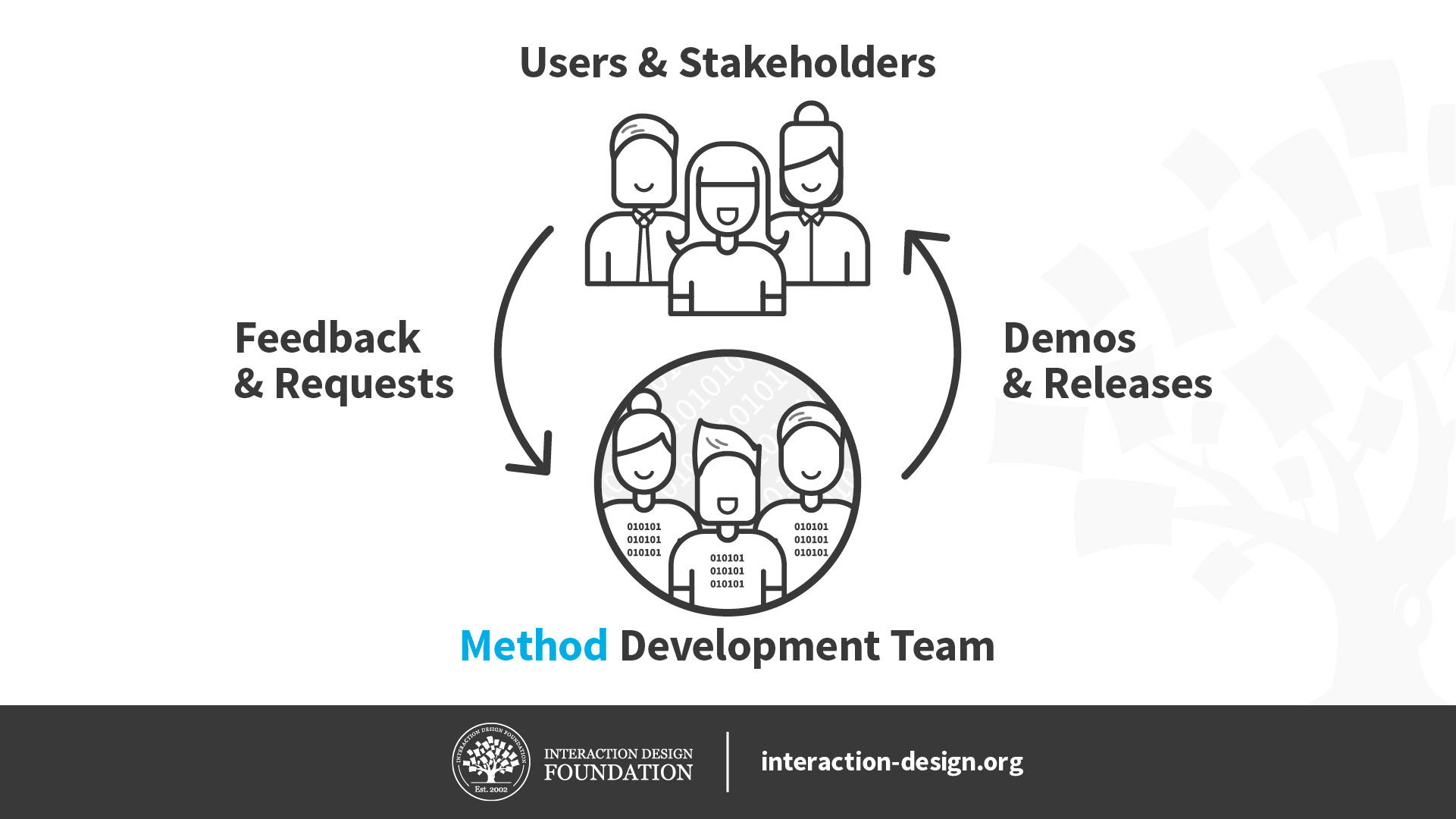
And it’s even better when combined with an agile methodology, an iterative approach to design and product development. Agile methodology helps to improve solutions through collaboration. This agile, collaborative environment breeds the ability to be efficient and effectively meet the stakeholders’ changing requirements.
Together, systems thinking and agile methodology lead us to a better solution at each iteration as they both evolve with the wicked problem.
In an agile methodology, every iteration incorporates feedback from the previous release. This process can help you tackle wicked problems when it’s combined with systems thinking.
5 Ways to Apply Systems Thinking and Agile Methodology in Your Work
If you’ve been faced with a wicked problem in the past, you’ll have undoubtedly experienced frustration from not knowing where or how to begin. There’s no shame in that—issues which are difficult or nearly impossible to solve will do that to a person! The next time you and your team must tackle a wicked problem, you can use these five handy methods which are based on systems thinking and agile methodology:
1. Break down information into nodes and links.
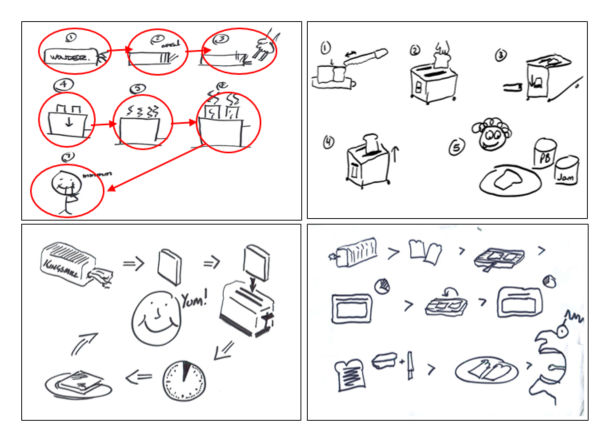
You can utilize systems thinking if you break the information down into nodes (chunks of information such as objects, people or concepts) and links (the connections and relationships between the nodes). This will make your private mental models (your representations of external reality) visible to the outside world and help you face wicked problems more effectively. Jay Wright Forrester, a pioneer in computer engineering and systems science, put it nicely when he said:
"The image of the world around us, which we carry in our head, is just a model. Nobody in his head imagines all the world, government or country. He has only selected concepts, and relationships between them, and uses those to represent the real system.”
—Jay Wright Forrester
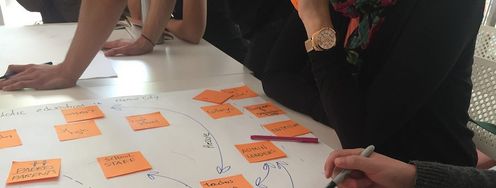
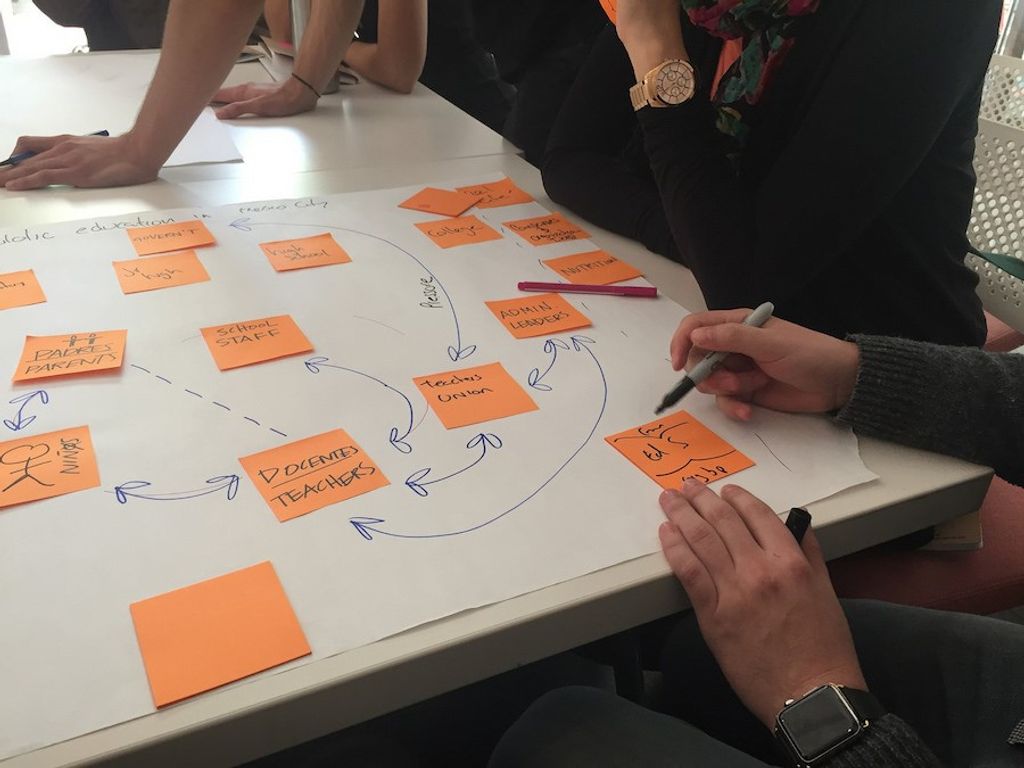
In this illustration, the nodes are circled in red and the links are the red lines drawn between the nodes. All four illustrations are systems models that participants created from Tom Wujec’s workshops on collaborative visualization and systems thinking.
When you sketch out and place information into a physical space, it will help both you and your team take in and understand the systems at hand—as well as the relationships within and between them.
3. Collaborate and include stakeholders in the process.
Share your mental models to help other people build on your ideas, and vice versa. Your team can synthesize several points of view when you create physical drawings and group notes to produce different systems models.
4. Release solutions quickly to gather continuous feedback.
Feedback of success helps to solve problems which we don’t have one single obviously correct answer for. The more feedback you gather from your users and stakeholders, the more guidance you’ll have to get to the next step.
5. Carry out multiple iterations.
You and your team have the chance to utilize feedback at each iteration. The more iterations you do, the more likely you’ll determine what changes are needed to further improve the solution to your wicked problem.
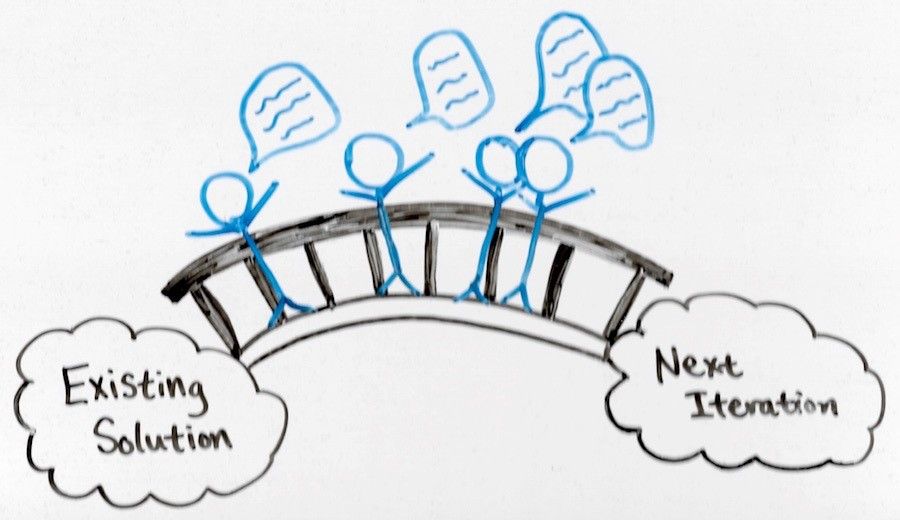
You’ll build a bridge between the existing solution and the next iteration when you combine user and stakeholder feedback with your team’s thoughts and ideas.
As designers, we have the responsibility to generate the best solution possible even when the wicked problem itself is indeterminate and the best solution does not yet exist. A combination of systems thinking and agile methodology can help us tackle these wicked problems. It encourages us to utilize these practices and share them with others so that we can, together, get to the next iteration of the design process.
When you start to tackle wicked problems, you can start to improve the world and the lives of the people who live in it. As a reminder, the five steps to do this are:
Break down information into nodes and links.
Visualize the information.
Collaborate and include stakeholders in the process.
Release solutions quickly and gather continuous feedback.
Carry out multiple iterations.
References & Where To Learn More
Ready to shape the future, not just watch it happen? Join the Father of UX Design, Don Norman, in his two courses, Design for the 21st Century and Design for a Better World, and turn your care for people and the planet into design skills that elevate your impact, your confidence, and your career.
AI is replacing jobs everywhere, yet design jobs are booming with a projected 45% job growth.
With design skills, you can create products and services people love. More love means more impact and greater salary potential.
At IxDF, we help you from your first course to your next job, all in one place.