UX maturity refers to the level of sophistication and effectiveness with which an organization approaches user experience (UX) design in its products, services, and processes. It's an assessment of how well a company understands, integrates, and values UX design and research. As an organization matures in UX, it typically moves through various stages, each stage represents a greater integration and appreciation of UX principles.
In this video, UX Designer, Author, Speaker and Podcaster Darren Hood discusses the meaning of UX maturity.
Why UX Maturity Matters
UX maturity is an important practice for several reasons—a high level of UX maturity brings significant benefits to organizations. Here's why it matters:
Enhanced User Experience and Satisfaction: A higher UX maturity An organization with a higher UX maturity level understands and implements user-centered design principles across the organization. This leads to products and services that are more intuitive, accessible, and enjoyable for users, which results in higher user satisfaction and loyalty.
Increased Business Success: There is a direct correlation between UX maturity and business outcomes. Better UX leads to higher engagement, improved conversion rates, and, ultimately, increased revenue. Companies with high UX maturity often successfully retain and expand their customer base. McKinsey and Company’s report, The Business Value of Design, revealed that companies that rank in the top quarter of the McKinsey Design Index (companies that exhibit high UX maturity, based on McKinsey's criteria) significantly outperformed their industry's average growth rate, achieving up to double the growth. Additionally, these top-ranking companies not only experienced higher revenue growth but also delivered greater returns to their shareholders.
Efficient Development Process: High UX maturity involves the integration of UX practices early in the development process, which reduces the need for costly redesigns and iterations later on. This efficiency not only saves time and resources but also leads to faster time-to-market.
Informed Decision-Making: Mature UX practices include regular user research and testing—this provides valuable insights into user needs and behaviors. These insights inform decision-making and ensure that products and services are closely aligned with user requirements.
Competitive Advantage: In markets where many products offer similar functionalities, UX can be a key differentiator. Companies with higher UX maturity can gain a competitive edge and outperform competitors with superior user experiences. PwC reports that 32% of customers will abandon a brand they love after just one bad experience. This underscores the critical role of positive user experience to maintain customer loyalty and brand reputation.
Enhanced Brand Reputation: Consistently delivering excellent user experiences strengthens brand reputation. Companies known for their focus on user experience are often seen as customer-centric and innovative.

Steve Jobs unveiled the original iPhone in 2007—a landmark moment in tech history. This iconic launch not only revolutionized communication but also exemplified Apple's commitment to exceptional user experience which bolstered its reputation as a customer-centric and innovative brand.
© Paul Sakuma, All rights reserved.
Scalability and Sustainability: As organizations grow, a higher level of UX maturity helps ensure that everyone keeps user experience at the forefront. This scalability is crucial to maintain quality and consistency across products and services.
Cultural Transformation: High UX maturity often reflects a broader cultural shift within an organization towards user-centricity. This shift can permeate all aspects of the business—this leads to more holistic and empathetic approaches to serving customers.
UX maturity is not just about improving the design of products and services; it's about adopting a user-centric mindset that can transform an organization and lead to greater success in an increasingly user-focused market.
How to Evaluate UX Maturity: Well-Known Frameworks
UX maturity models are frameworks that help organizations assess and understand their current level of proficiency in UX design and strategy. These models typically outline a progression of stages or levels through which an organization can advance its UX capabilities. Each level represents a greater understanding and integration of UX principles and practices within the organization.
In this video, Darren Hood talks about UX maturity models and their similarities.
Here are some well-known UX maturity models:
Nielsen Norman Group’s UX Maturity Model
This model initially had 8 stages, ranging from "Hostility toward usability" to "User-driven corporation," but it has since been revised to a 6-stage model. This streamlined model guides organizations from an "Absence of UX," where UX is unrecognized, through stages of growing awareness and integration ("Limited UX" and "Emergent UX"), to structured and formalized UX practices ("Structured UX"), and ultimately to stages where UX is deeply embedded in the organizational culture and strategy ("Integrated UX" and "User-Driven Corporation").
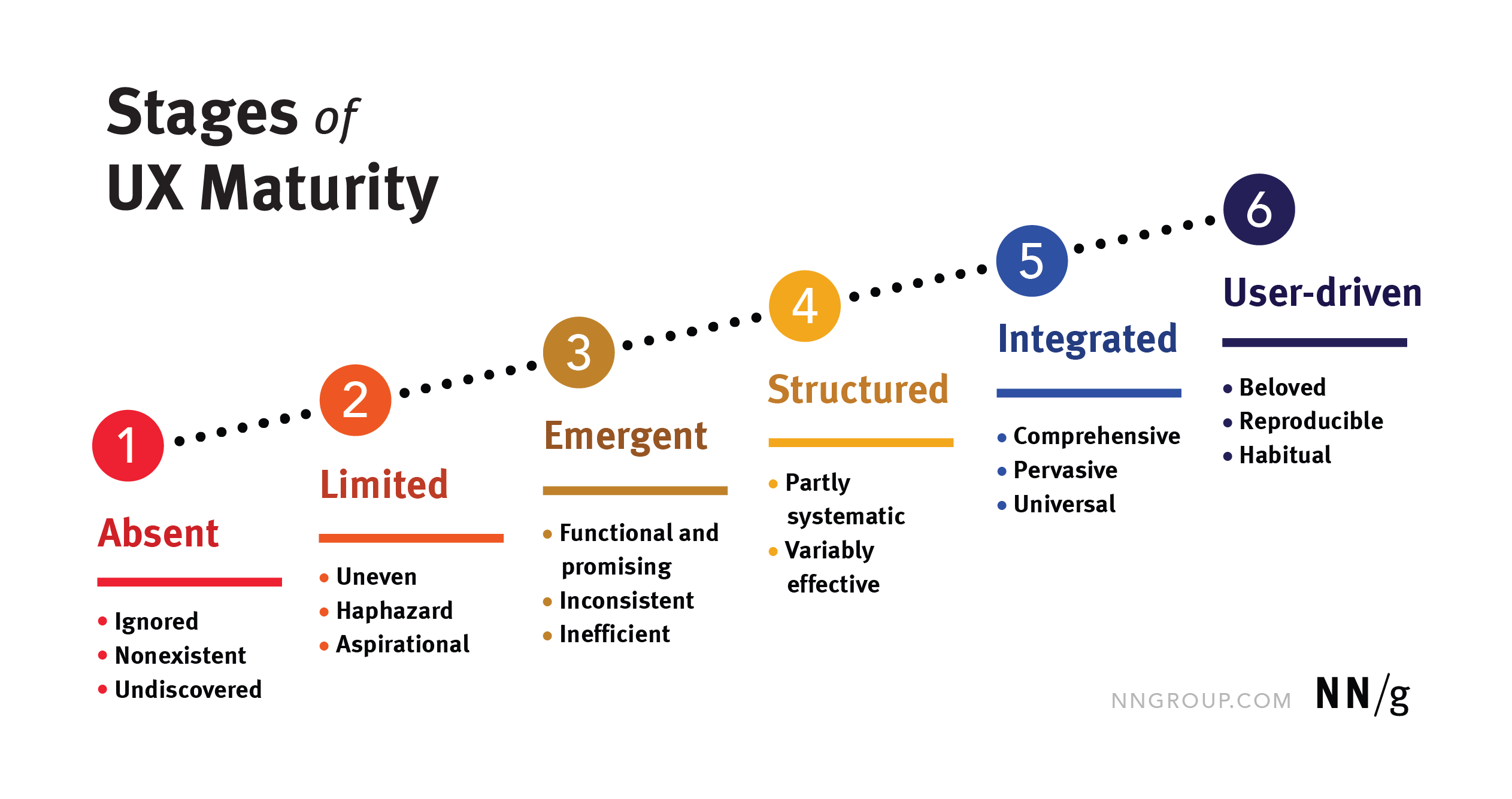
The revised version of the Nielsen Norman Group’s UX Maturity has six steps.
© Nielsen Norman Group, Fair Use
The NN Group's model assesses UX maturity through:
Awareness and Integration: From an initial absence of UX awareness to full integration in strategies and processes.
Organizational Adoption: The extent to which UX is adopted throughout the organization, from leadership to operational levels.
User-Centricity in Decision-Making: How user needs and feedback influence decision-making and product development.
This model is instrumental in guiding organizations from a lack of UX focus to a culture where UX drives business strategy and innovation.
Design Management Institute’s Design Maturity Model
The Design Management Institute’s Design Maturity Model progresses through five levels to categorize organizational design processes. It begins at the Initial stage, where organizations apply design practices in an ad-hoc and unstructured manner. The Repeatable level sees organizations developing basic design processes, though they may not apply these consistently across all areas. At the Defined stage, organizations systematically document and standardize their design processes. In the Managed stage, they actively oversee and measure these processes, optimizing them for continuous improvement. The final level, Optimized, marks a stage where organizations continually refine their design processes, and thus drive business strategy and lead innovation. DMI evaluates UX maturity by assessing the integration depth and effectiveness of design in an organization’s processes and culture, the level of organizational engagement and support for design, and the impact of design-led approaches on innovation, market adaptability, and financial performance.
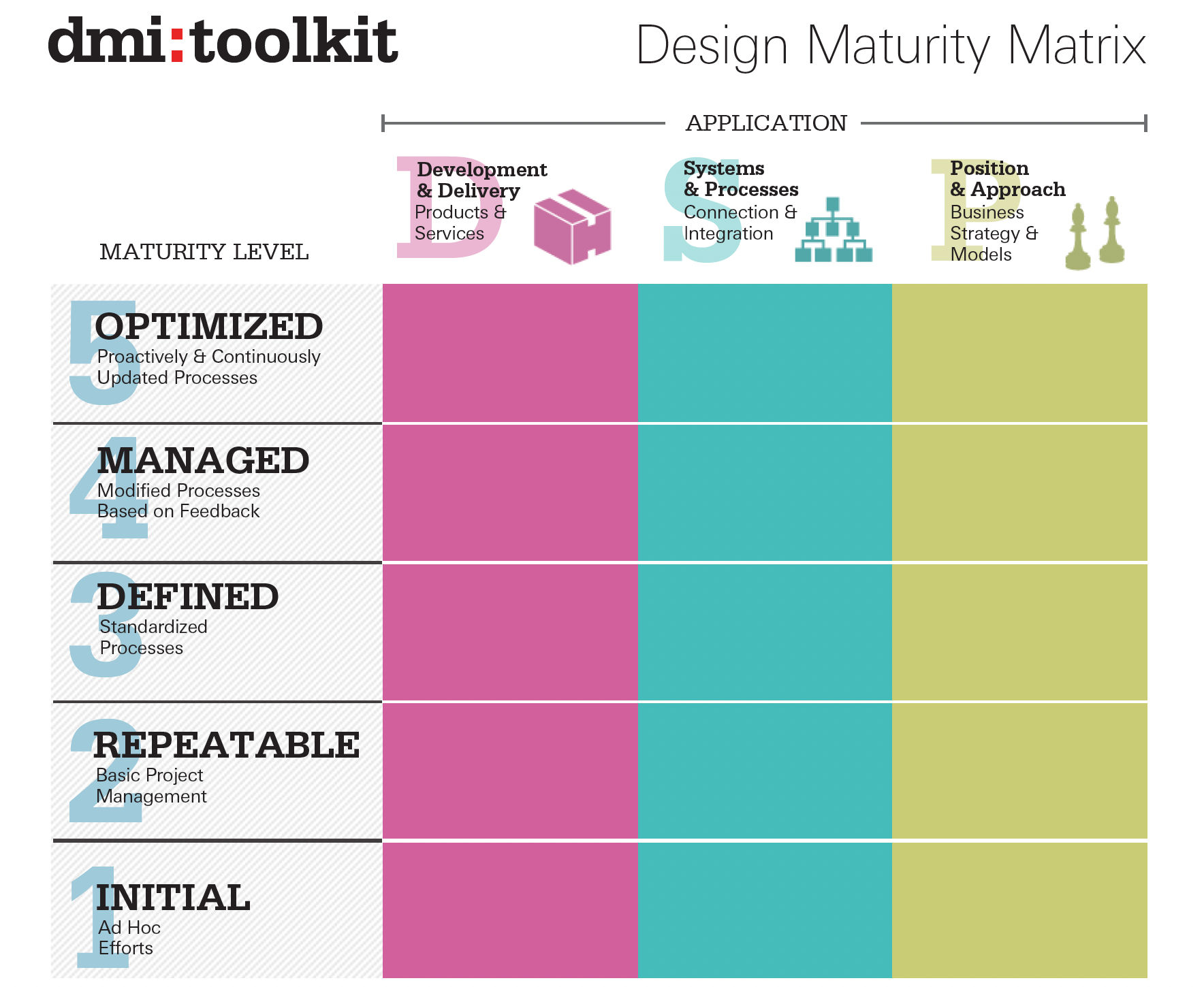
Design Management Institute's Design Maturity Matrix has five progressive levels: Initial, Repeatable, Defined, Managed, and Optimized.
© Design Management Institute, Fair Use
Spool’s UX Maturity Model
Jared Spool's UX Maturity Model outlines the evolution of UX in an organization across five distinct stages. The model begins with the Dark Ages, a phase where organizations do not recognize or implement UX practices. As they progress to the Spot UX Design stage, organizations start to recognize and sporadically apply UX practices. The UX Design as a Service stage involves establishing formal UX roles and services. In the Embedded UX Design stage, organizations integrate UX practices into product teams, making them a standard part of the development process. The final stage, Infused UX Design, places UX principles at the forefront of strategic decisions, embedding them deeply into the organization's culture and operations. This model acts as a roadmap, guiding organizations to evolve their UX practices from initial, rudimentary efforts to fully integrated, strategic UX methodologies.
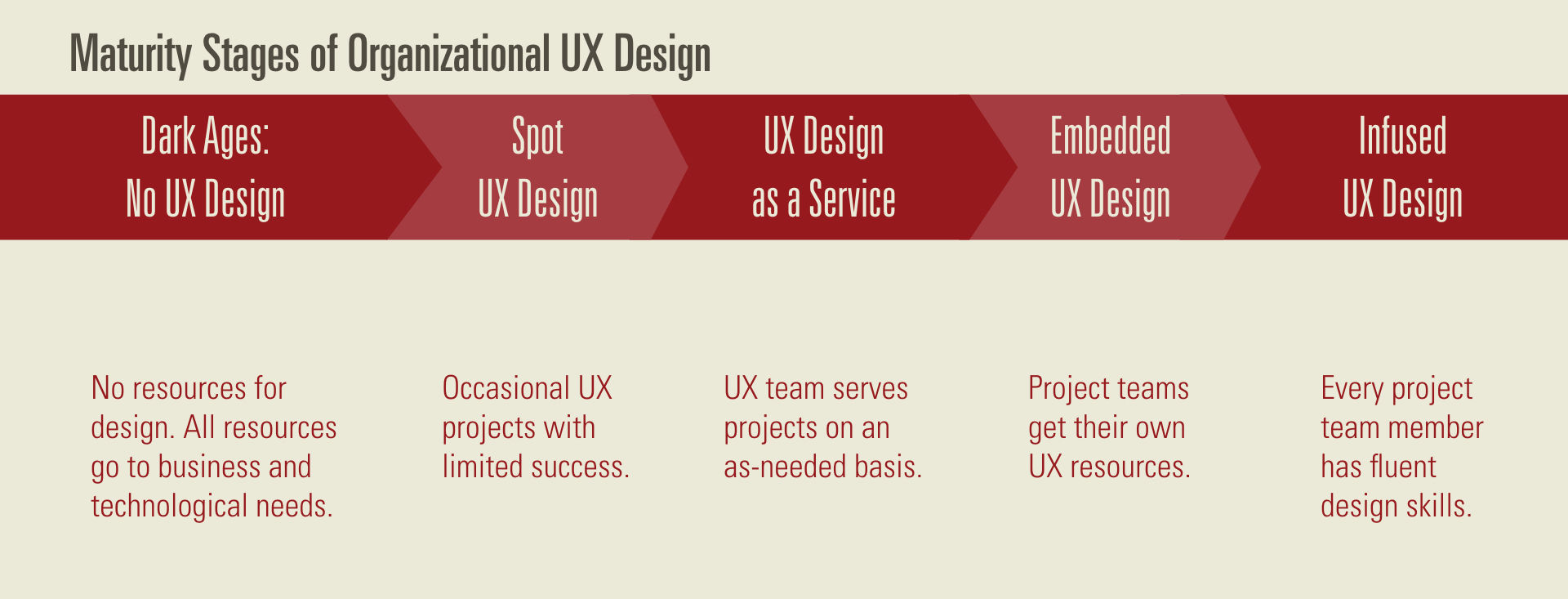
Jared Spool's UX Maturity Model shows the journey from the "Dark Ages" of UX to the "Infused UX Design" stage, where UX principles become a core part of organizational strategy and culture.
© Jared Spool, Fair Use
These models provide a slightly different perspective on UX maturity, but they all share a common goal: to help organizations understand their current UX capabilities and identify areas for improvement. When organizations implement these models they can strategically advance their UX practices—resulting in better user experiences and enhanced business outcomes.
The Key Stages of UX Maturity
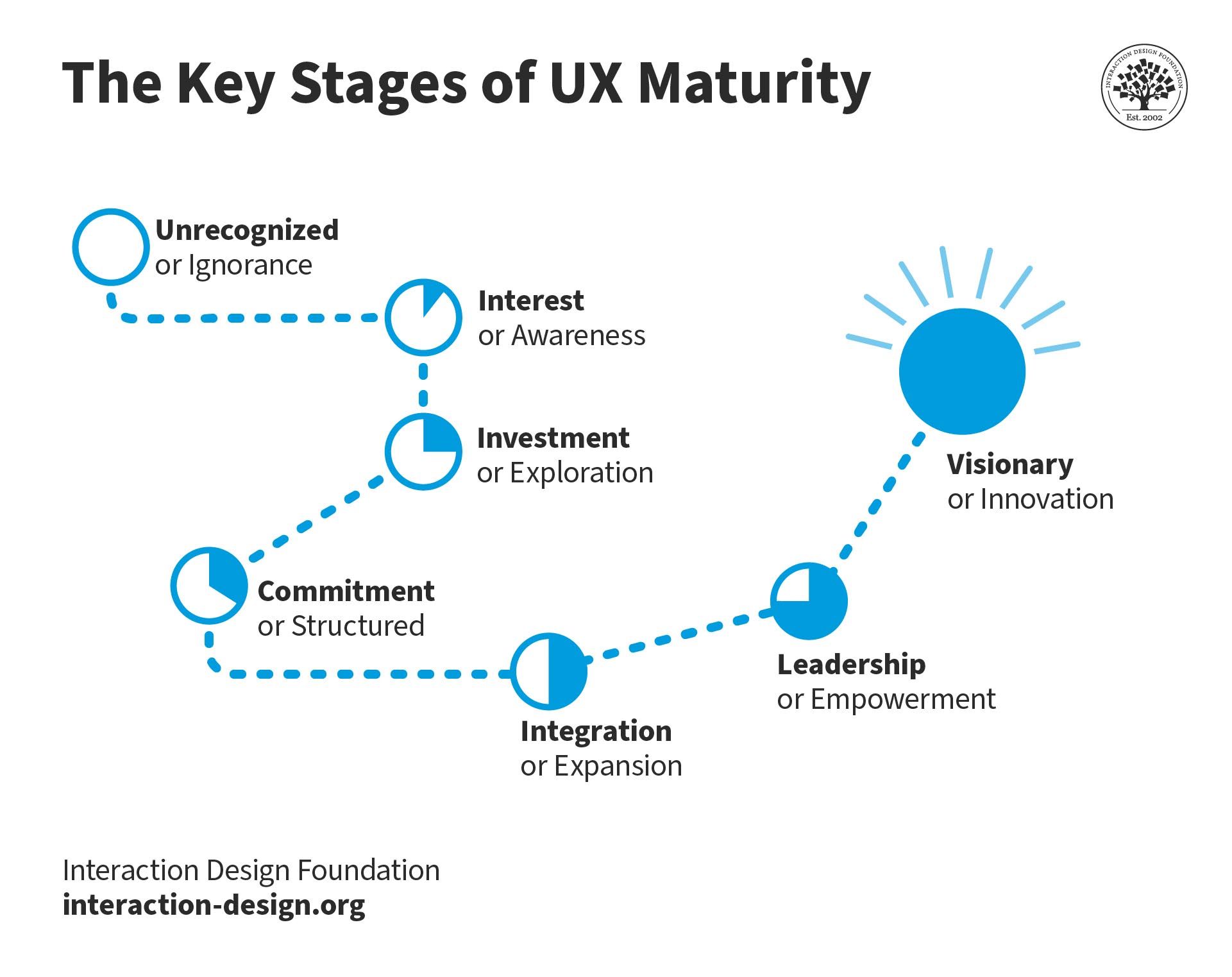
The phases of UX maturity vary depending on the specific model being referenced, but there are common themes across most models. Typically, these phases progress from an initial lack of awareness or understanding of UX, through to a stage where UX is fully integrated and drives strategic decisions. Here's a synthesis of the most common or well-known phases in UX maturity models.
© Interaction Design Foundation, CC BY-SA 4.0
Unrecognized or Ignorance: At this stage, the organization has little to no awareness of UX. User experience is not considered in product or service design, and there is no dedicated UX staff. Decisions are made with little regard for the end user.
Interest or Awareness: The organization starts to recognize UX but lacks deep understanding or commitment. There may be some ad-hoc UX efforts, but no formal strategy or dedicated team. Interest in UX principles begins to develop.
Investment or Exploration: The organization begins to invest in UX by hiring professionals or contracting external UX services. There is an acknowledgment of the value of UX, but it's still not fully integrated into processes.
Commitment or Structured: At this level, there's a structured approach to UX. The organization invests in a UX team and integrates UX into some projects. UX principles begin to inform decision-making, but there may be inconsistencies in application across the organization.
Integration or Expansion: UX is integrated into all relevant aspects of the organization. It's a part of the culture and is considered in all project life cycles. User-centered design becomes a standard approach.
Leadership or Empowerment: The organization is seen as a leader in UX. UX drives innovation and is deeply embedded in the company's strategy. There is a strong focus on continuously improving the user experience, and the organization often sets trends in UX.
Visionary or Innovation: At the highest level, the organization not only integrates UX fully but also innovates in the field. The company sets benchmarks for UX and is often looked to as a model of best practice. UX is a key driver of business strategy and product innovation.
These phases represent a continuum of maturity in the understanding, integration, and value of UX. Organizations may progress through these stages at different rates, and some may plateau at certain stages depending on various factors like leadership support, culture, and resources available.
How to Assess an Organization’s UX Maturity Level
It’s crucial to assess an organization's UX maturity level to understand where it stands in terms of user experience integration and where it needs to improve. Here's a guide for organizations to assess their UX maturity level:
1. Conduct a Self-Assessment Survey
Survey Development: Create a survey that includes questions related to the key aspects of UX maturity, such as UX processes, user research, design practices, and organizational culture.
Broad Participation: Encourage a wide range of employees across different departments to participate in the survey to get a comprehensive view of the organization’s UX maturity.
2. Review Existing UX Processes and Outputs
UX Process Evaluation: Examine current UX processes, including design, research, and testing methodologies. Assess their consistency, depth, and integration in product development.
Quality of UX Deliverables: Analyze the quality and effectiveness of UX deliverables like wireframes, prototypes, user research reports, and usability studies.
3. Analyze the Integration of UX in Business Strategy
Strategic Alignment: Evaluate how well UX is integrated into the business strategy. This includes looking at how UX considerations influence product roadmaps, business decisions, and overall company objectives.
Leadership Involvement: Assess the extent of UX understanding and support among the leadership team.
4. Evaluate the Organizational Culture around UX
Employee Awareness: Gauge the general awareness and attitude towards UX within the organization. This includes how well non-UX staff understand and value UX principles.
Cross-Departmental Collaboration: Look at how different departments collaborate on UX matters. High UX maturity often involves seamless collaboration between UX teams, developers, product managers, and marketers.
5. Assess Resources and Investment in UX
Resource Allocation: Review the resources allocated to UX, including budgets, tools, and personnel. Assess whether these resources are sufficient and effectively utilized.
Training and Development: Evaluate the opportunities for training and professional development provided to UX staff.
6. Measure UX Impact and ROI
User Feedback and Metrics: Analyze user feedback and metrics such as user satisfaction scores, conversion rates, and usability test results to understand the impact of UX efforts.
ROI Analysis: If possible, conduct a return on investment (ROI) analysis of UX activities to quantify their impact on business success.
7. Conduct External Benchmarking
Industry Comparison: Compare the organization’s UX practices with industry standards or competitors. This can involve researching best practices in the industry and assessing how the organization measures up.
Expert Evaluation: Consider engaging external UX consultants or experts to provide an unbiased assessment of the organization’s UX maturity.
8. Create a UX Maturity Report
Documentation: Compile the findings from the above assessments into a comprehensive UX maturity report. This report should highlight strengths, weaknesses, and areas for improvement.
Actionable Recommendations: Based on the assessment, develop a set of actionable recommendations to enhance the organization’s UX maturity.
9. Regular Review and Update
Ongoing Assessment: UX maturity is not static. Regularly reassess your organization’s UX maturity to track progress and make ongoing improvements.
An organization can gain a clear understanding of its current UX maturity level and identify specific areas where it can improve to advance its UX capabilities and overall business success by methodically assessing these areas.
How to Enhance UX Maturity: Steps for Organizational Improvement
There are several steps organizations can take if they want to improve their UX maturity level.
1. Recognize the Value of UX: Organizations must first acknowledge the significance of UX in achieving business goals. This involves understanding that UX is not just about aesthetics but is a strategic component essential for customer satisfaction, increased sales, and gaining a competitive edge.
2. Strategic Investment in UX: To advance in UX maturity, organizations should invest in skilled UX professionals and necessary tools. This means not only hiring designers and researchers but also providing them with the resources and technology needed to create high-quality user experiences.
3. Integrate UX in Business Processes: Mature organizations integrate UX from the early stages of product or service development. This integration ensures that UX considerations are part of the decision-making process and not just an afterthought.
4. Establish UX Governance and Leadership: Effective UX governance and leadership are crucial. Organizations should establish clear UX roles and ensure that UX principles are championed at the executive level, which reflects a commitment to user-centered design.
5. Cultivate a User-Centered Culture: A culture where every team member values UX and adopts a user-first approach is vital. This cultural shift is key to creating products and services that genuinely meet user needs.
6. Commit to Continuous Learning: UX maturity requires a commitment to continuous learning and adaptation. Organizations should regularly update their UX strategies, methodologies, and tools to align with evolving user needs and technological changes.
7. Measure and Assess UX Impact: Understanding and quantifying the impact of UX on business outcomes is important. Metrics related to user satisfaction, engagement, and conversion rates provide valuable insights into the effectiveness of UX initiatives.
8. Emphasize User Research and Testing: Regular user research and usability testing are fundamental in mature UX practices. These activities are crucial to gain insights into user needs, behaviors, and preferences, which inform design and development.
9. Foster Collaboration Across Disciplines: Mature UX practices thrive on collaboration across various departments. UX professionals should work in tandem with product managers, developers, marketers, and other stakeholders to ensure a cohesive approach.
10. Align UX Strategy with Business Objectives: The UX strategy should align with the overall business strategy. It’s essential to ensure that UX efforts support and contribute to the organization's broader goals and vision.
Organizations can increase their awareness of UX maturity and systematically improve their UX practices through these steps. This will lead to a better user experience and enhanced overall business performance.