Product Management

Your constantly-updated definition of Product Management and collection of videos and articles.
Be a conversation starter: Share this page and inspire others!

197 Shares

What is Product Management?

Product management is the practice of applying an understanding of user needs, business objectives and technology to create products that provide seamless user experiences and meet business goals. Product managers combine their skills with those of designers. Their primary role is to identify and articulate the user needs and business objectives that a product must address. 

What does Product Management Mean in Design?

Product management (PM) and user experience (UX) design are two distinct disciplines—yet they’re intertwined. And they both play crucial roles in terms of how brands make successful products—and the people who work in these fields often find themselves straddling the thin line that separates the definition of what they do. It’s a phenomenon of sorts that’s led to the emergence of a new breed of professionals—and they’re called UX product managers. 

The role of a UX product manager is—in a nutshell—to understand the customer's needs and to translate them into product features that truly do meet those needs. An important part of this is that these managers have got to work with UX designers—and that’s so they can develop user-centric designs that solve customers’ problems and reflect a solid understanding of their user flows. These UX product design managers must also collaborate with product owners or stakeholders and engineers to make sure the product meets all necessary requirements. What’s more, they’re at the helm to set product strategy, create business plans, launch products and manage market research initiatives

Ultimately, these managers are responsible for making sure of the successful delivery of a product that meets customers’ expectations and drives business growth. Particularly when product managers work with cross-functional teams, they have to strive to construct a unified, smooth and solid “runway” to help digital products launch successfully into their target audience as optimal product experiences.  

The role has both a technical and creative dimension—and it calls for a combination of skills. These include user experience design, project management, strategic thinking, analytics, communication skills, problem-solving abilities and leadership capabilities.  

A successful UX product manager has got to have a deep understanding of their users’ needs. What’s more, a manager must be able to get these needs across to multiple stakeholders—and effectively so. They’ve got to be able to identify trends in the market and create strategies that actually meet customer demands and do it well. And they must understand the customers’ needs and translate them into product features that really do meet those needs. Empathy for the target audience must—therefore—be a core concern of both the design team and the product manager in any given project. 

This video explains empathy, and why it’s vital in design and product management: 

Transcript
 

By definition, a UX product manager is a unique professional who combines the skills of a product manager and a UX designer. They define what success looks like for a product and rally a team towards the realization of that vision.  

However—unlike traditional product managers in the design of physical products—UX product managers also have a deep understanding of UX design principles and methodologies. This equips them with the ability to guide the product design process to ensure user needs are at the forefront of every decision at every stage of the product’s development. The role and responsibilities involve unique perspectives on product ideas, product concepts, marketing strategies, the target market and other factors.  
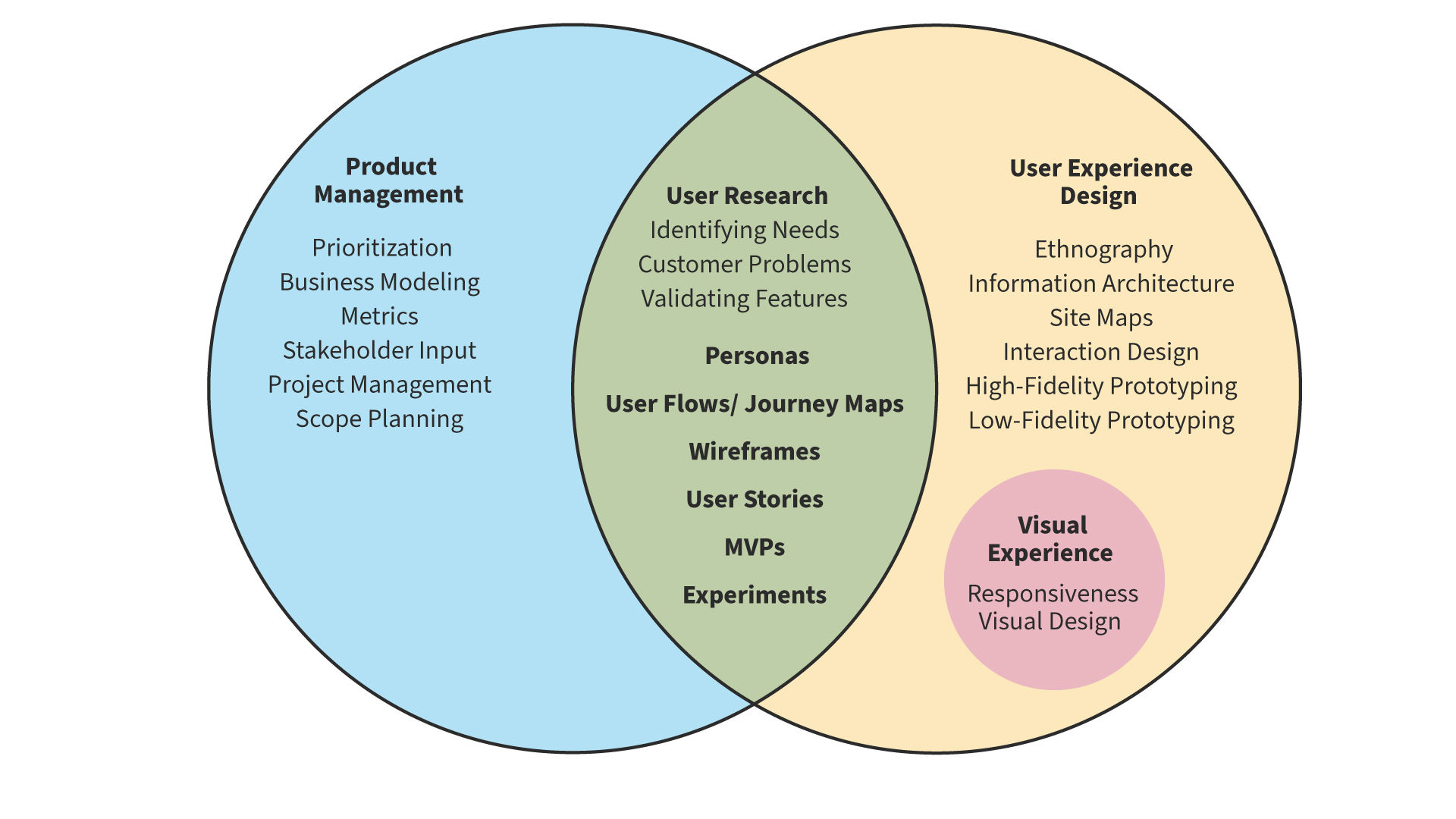
A Venn diagram showing functions of product managers and UX designers.

There is much overlap between a product manager and a UX designer.

© Suruchika Choudhary, Fair Use

Where does Product Management Intersect with UX Design?

The roles of product managers and UX designers often do overlap in several key areas—and that’s why considerable confusion can come about. Namely, there's confusion over who should be responsible for what. From a broader perspective—though—it becomes clear that these roles complement each other rather than compete. 

Managers and designers share a goal—and the thing that they’ve in common here is to create products that meet users' needs while these products achieve business objectives. Product managers and designers both focus on the user, and they both conduct research so they can deeply understand their needs. What’s more, they use those insights to guide the product development process. 

Product managers typically focus on strategic aspects—such as to set the product vision, prioritize features and align stakeholders. Meanwhile, UX designers get right down into the details of the user interface—and create wireframes, prototypes and the final pieces of visual design. They also do usability tests to make sure that the product’s easy to use and that it meets users' needs. 

In essence, product managers define the “what” and “why” of the product—while UX designers determine the “how.” Together, they make sure that the product solves a problem for the users and does so in a way that’s engaging and delightful. They’re two major parts of why a finished product has got such a competitive advantage—and they’re vital to any business case. 

The Journey from UX Designer to UX Product Manager

There’s an especially common question that tends to crop up in UX design—and it’s whether a UX designer can transition into a product management role. And the answer is a resounding “yes.” In fact, many successful product managers did start their careers as UX designers—before they shifted across the design team. 

To make the transition from designer to manager, one’s got to expand one's skill set to include strategic thinking, business acumen and leadership abilities. UX designers already tend to have a deep understanding of user needs—and it’s a skill that’s critical in product management. UX designers can build on this foundation and learn about business strategy, market analysis and project management. When they do that, they’ll be in a place where they can effectively transition into the role of UX product manager. 

Product managers can succeed in product management if they:  

  1. Assume an active role in idea generation and advocate for the user and user control. They’ve got to be able to communicate ideas clearly and concisely. 

  1. Research the market. Product managers should research the market thoroughly—to understand user needs, competitive products or services, and trends in the industry. This activity will help them develop an effective product strategy. It will be one that meets user needs in terms of products to market and keeps up with the competition. 

  1. Build strong relationships with stakeholders—such as developers, designers and executives—to make sure a smooth product development process becomes and remains a reality. Managers should also nurture relationships with customers and users to make sure that they create a product that really does meet their needs. 
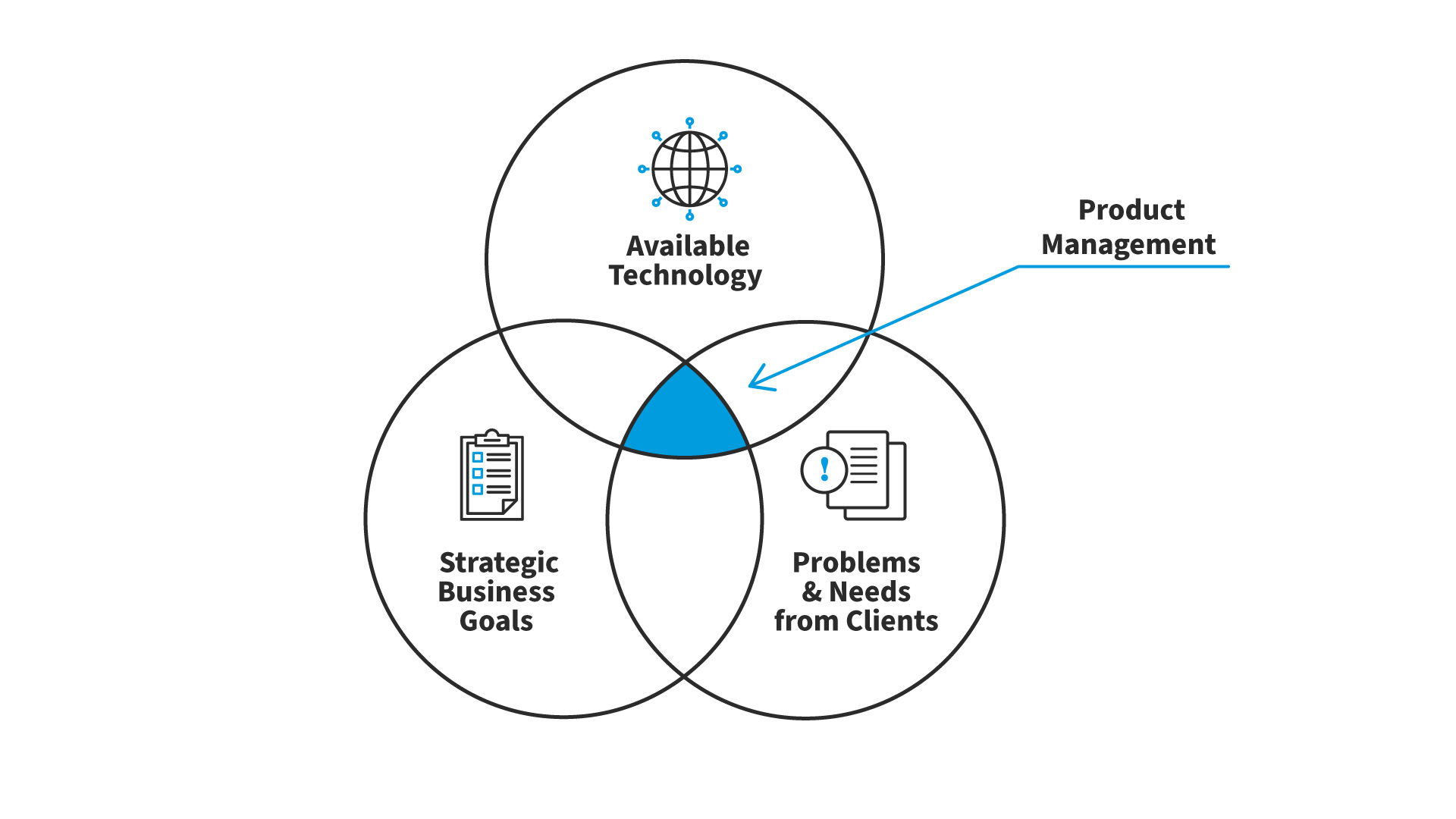
    A diagram of three intersecting circles showing where product management is.

    Product management dwells in a special place in the UX world.

    © Joca Torres, Fair Use

What does Effective Product Management Involve?

Effective product management in UX design has five stages: Discovery, Design, Test, Build and Measure. Each of these stages plays a role that’s utterly critical to make sure that the product doesn’t just meet the users' needs—but aligns with the business objectives, too. 

1.  Discovery: It’s the initial stage, and it’s all about understanding the market and the users—and the problem that’s in need of a solution. It involves extensive user research and analysis to get insights that will inform the design process. 

2.  Design: As it leverages the insights from the discovery phase, this stage focuses on making solutions—and to visualize the potential product, it takes ideation, sketching and prototyping. 

3. Test: Before the prototype can move on into development, it undergoes rigorous testing with real users. It’s a crucial phase—to collect feedback and make needed adjustments to improve the product. 

4.  Build: Now they’ve got a refined design, the product development team then builds the solution. This phase calls for developers, UX/UI designers and product managers to work closely to bring the vision to life. 

5.  Measure: After the launch, the manager continuously monitors the product against key metrics and user feedback. This data informs future iterations—plus, it makes sure the product evolves to meet changing user needs. 

Image of an iPhone

The iPhone is one famous example of exceptional product management. Apple thoroughly understood their market before launching an innovative, intuitive and now iconic product that has proven perennially popular.

© Apple, Fair Use

In the age of Agile design, visual roadmaps have become indispensable tools for product managers. These roadmaps serve not just as a plan but as a strategic communication tool that gets the team and stakeholders aligned around both the vision and progress of the product, too. Key elements of an effective visual roadmap include: 

  • Themes: They articulate the overarching goals and narratives of the product—and make sure every team member understands the “why” behind their work. 

  • Color-coding: This visual cue links work items to specific outcomes, goals or priorities—and it makes it easier for the team to stay focused on what matters most. 

  • Strategic focus: As it highlights items of strategic importance, the roadmap makes sure that the design team do indeed concentrate their efforts on initiatives that drive the most value. 

There’s a synergy between these stages and the strategic use of visual roadmaps—and it’s something that really exemplifies effective product management in UX. Product managers aim to take a methodical approach—one that emphasizes discovery, user-centric design, testing and continuous measurement. That way, they can steer their products towards being successful ones. What’s more, the use of themes, color-coding and a focus on strategic priorities within roadmaps makes sure that the entire team’s on the same page—and moves towards achieving the desired outcomes and goals. 
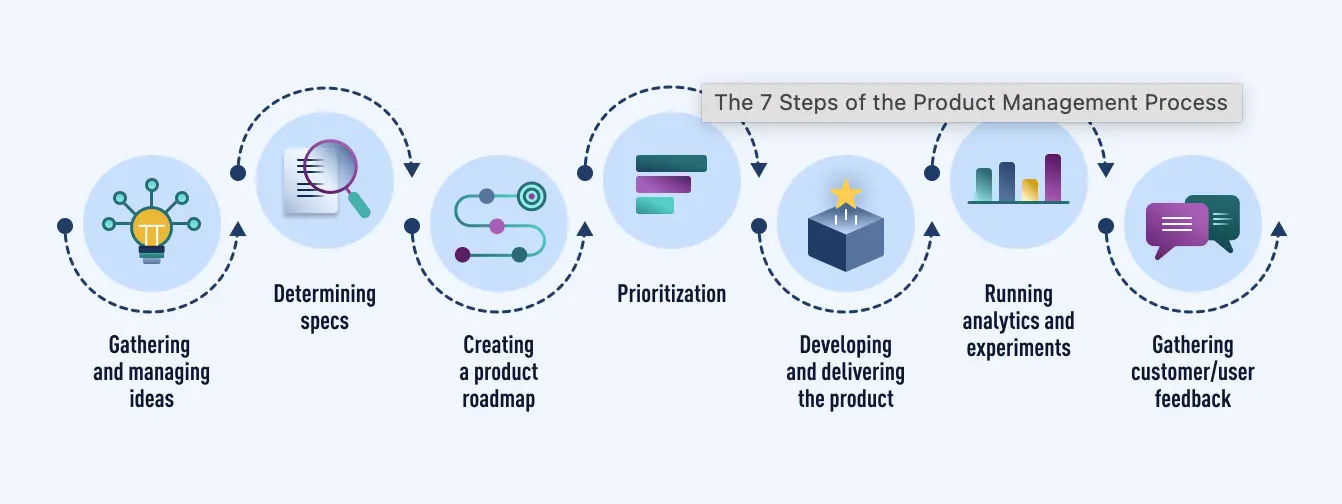
Diagram of a product manager's work process.

This is one example of a product manager’s work process.

© User Experience, Fair Use

What are Key Strategies for Exceptional Product Management in UX?

Several key strategies are vital must-haves—and they don’t just streamline the product development process; they make sure that the end product resonates deeply with users, too. Below, here’s a detailed exploration of these: 

1. Have Regular Interaction with Customers and Feedback Analysis

  • Engage in continuous dialogue with existing customers—to keep up with market trends. 

  • Analyze feedback meticulously—to find areas for improvement and innovation. 

This approach is something that makes sure the product does evolve in step with user needs and preferences—and that it nurtures users’ loyalty, plus optimizes their satisfaction levels. 

2. Prioritize Features Aligned with the Product Vision

  • Implement a structured framework for feature prioritization—and do it so it’s really in line with the overarching product vision. 

  • Don’t waste effort—by focusing development on features that truly contribute a great deal to the product's strategic goals. 

This strategy prevents resources from getting wasted—plus, it keeps the development team well and truly focused on delivering value. 

3. Conduct In-depth User Research and Maintain Empathy

  • Do comprehensive user research—through interviews, surveys and observation—to drill down and get a really deep understanding of user behaviors, preferences and pain points. 

  • Empathize with users. It’s vital to put oneself in their shoes—and to aim to create experiences that truly suit their needs. 

This foundation of empathy and insight acts as a vital guide—plus, it helps make sure that products are both very user-centric and highly engaging. 

UX Strategist and Consultant, William Hudson explains how important user research is in this video: 

Transcript
 

4. Ensure Cross-Functional Collaboration and Innovation

  • Nurture a culture of collaboration; get cross-functional teams productively involved in brainstorming sessions. 

  • Encourage the team to explore diverse design solutions—and really tap the team’s collective creativity and expertise. 

This collaborative environment is something that doesn’t only generate innovative ideas—it makes sure that various perspectives manifest in the design process as well. 

UX Designer and Author of Build Better Products and UX for Lean Startups, Laura Klein explains the value of cross-functional teams: 

Transcript
 

5. Do Rapid Prototyping and Gather User Feedback

  • Do rapid prototyping to quickly validate design concepts and collect user feedback. 

This iterative process allows for swift adjustments based on user input. It makes sure that the UX really aligns with user expectations before final development becomes a reality. 

Author and Human-Computer Interaction Expert, Professor Alan Dix explains prototyping and the need for it: 

Transcript
 

6. Strategically Design Elements to Enhance Usability

  • Structure content and design intuitive navigation systems to streamline the user journey. 

  • Apply typography, color schemes and imagery to create visually appealing and intuitive interfaces. 

These design choices not only give a boost to the product’s aesthetic appeal; they also improve its usability, and reduce friction and elevate user satisfaction as well. 

Principal and Owner of Lebsontech LLC, Cory Lebson explains usability in this video: 

Transcript
 

7. Prioritize Accessibility and Inclusivity

  • Make it a priority to make accessible experiences—think about the diverse needs of users, including those with disabilities. 

  • Stick to accessibility guidelines and standards—such as the Web Content Accessibility Guidelines (WCAG)—to make sure that the product really is usable and enjoyable for everyone. 

See why accessibility is such a vital consideration in any design: 

Transcript
 

8. Apply Data-Driven UX Optimization

  • Use analytics tools to track relevant metrics and assess what the impact of UX design is on the product's success. 

  • Regularly analyze data to spot trends—and iterate based on measurable outcomes and user feedback. 

This data-driven approach is something that really enables the continuous optimization of the UX. It makes sure that the product will stay competitive and meet user needs as they evolve. 

William Hudson explains when and why to use analytics in this video: 

Transcript
 

9.  Advocate for Customer Needs

  • Always prioritize the customers’ needs; make sure that the product runs in line with market trends and what users expect to find. 

10. Practice Good Self-Management and Social Awareness

  • It’s a vital thing for a manager to develop strong self-management skills to handle tight deadlines and market demands—all while keeping a strong sense of social awareness to understand and address customer emotions and concerns. 

Key Metrics to Measure UX Impact

To do an assessment of how effective UX product management is, it's vital to track key performance indicators (KPIs). These metrics give helpful insights into how well UX and product management efforts resonate with a brand’s users. They also show where to make improvements—for example, in the visual hierarchy of a user interface (UI).  

CEO of Experience Dynamics, Frank Spillers explains a central part of product management: 

Transcript
 

Some key UX product manager metrics to consider include: 

1. User Satisfaction 

Use surveys or interviews to gauge users' overall satisfaction with the product. 

2. Task Completion Rate

Measure the percentage of users who successfully complete a specific task or goal within the product. 

3. Time on Task

Track the average amount of time it takes users to finish a particular task or action. 

4. Conversion Rate

Monitor the percentage of users who take a desired action—such as to sign up for a newsletter or make a purchase. 

5. Retention Rate

Assess the percentage of users who continue to use the product over time.
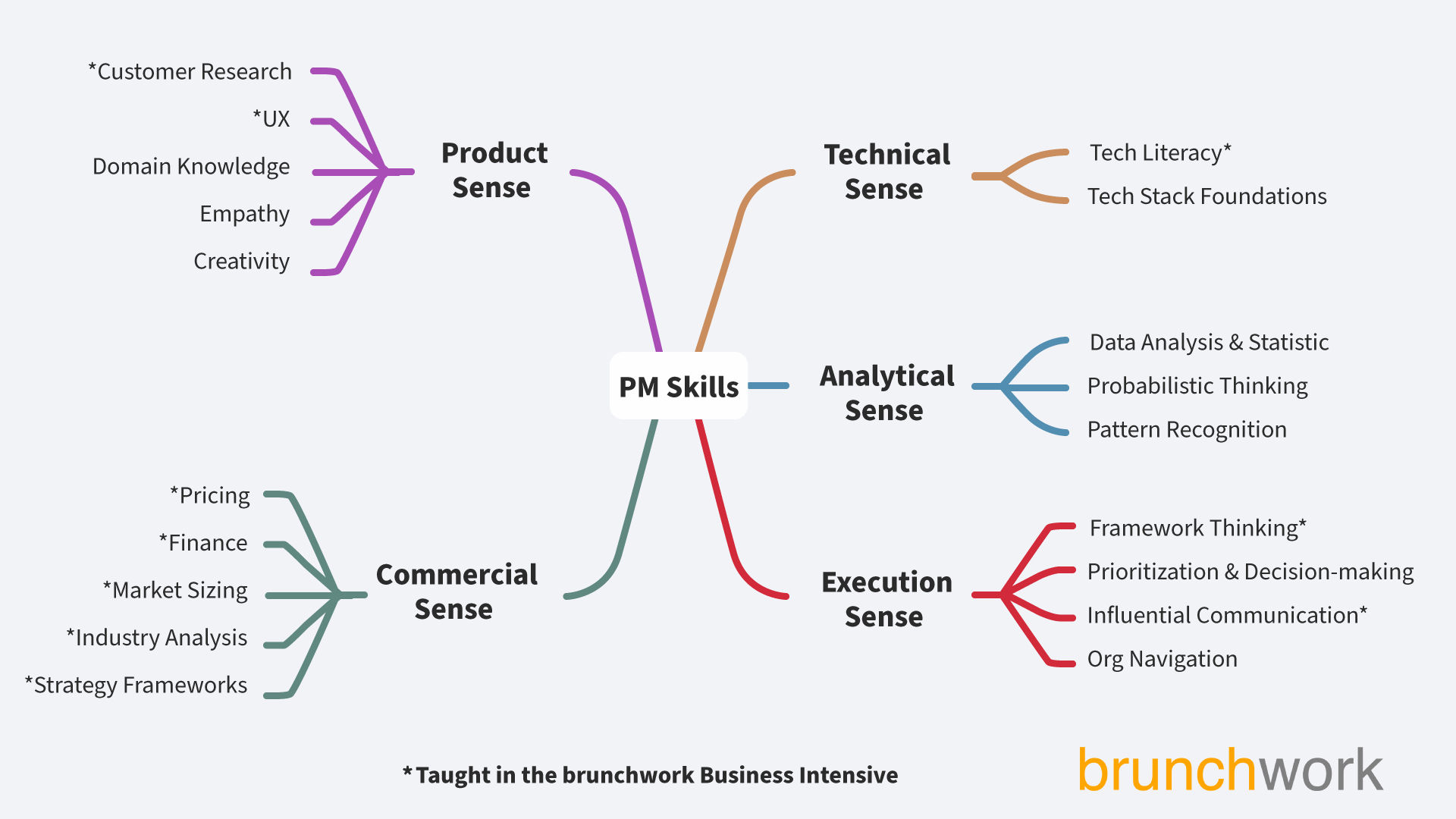
A diagram showing where a product manager's skills are.

The skills of a product manager delve into a variety of essential dimensions.

© Benjamin Miller, Fair Use

Good UX product managers understand user needs, business objectives and emerging trends in UX design. So, they can drive product development strategies that lead to successful product launches and stable final products. 

Questions About Product Management?
We've Got Answers!

How can someone transition into a product management role?

Get the relevant skills and experience and understand the responsibilities of what it takes to manage a product from conception to launch. Here's how you can make this transition: 

  • Educate yourself: Online courses, workshops and reading material on product management deliver a solid foundation on and for it. 

  • Get related skills: Product managers need a broad skill set—including market analysis, UX design and project management. Develop these skills through courses, projects, or roles that touch on these areas. 

  • Gain experience: Look for opportunities to work on product-related projects within your current job—even if it's not in a product management role. Volunteer for tasks that involve market research, user testing or product strategy. 

  • Network with product managers: Join product management groups or forums online and go to industry meetups to connect with current product managers. Networking gives really useful insights into the role—plus, it could lead to mentorship or job opportunities. 

  • Showcase your skills: Build a portfolio that includes case studies of your work—especially for any projects where you had a direct impact on the product strategy—or development. It’s something that can be really crucial to show how capable—and well-suited—you are for a product management role. 

  • Apply strategically: Look out for product management roles that really match your experience and skills—and tailor your resume and cover letter to highlight relevant experience and skills that are in line with a product manager’s responsibilities. 

If you follow these steps and demonstrate a passion for product development and strategy, you can successfully—transition into a product management role. 

Take our Master Class How to Manage Personal UX Maturity with Darren Hood, UX Designer, Author, Speaker and Podcaster. 

What educational background benefits a product manager?

A product manager benefits from an educational background that combines business, technology and design. While there isn't a one-size-fits-all degree for product managers, certain fields of study really do stand out for how relevant they are to the role. 

  • Business and management: Courses in business administration, marketing, finance and strategic management are really helpful ways to equip product managers with the skills they need to understand market needs, develop business strategies—and manage product lifecycles. 

  • Computer science or engineering: A technical background is something that can help product managers communicate effectively with development teams, understand the technical challenges of product development—and make informed decisions on technical trade-offs. 

  • Design: Knowledge in design principles, UX design or graphic design empowers product managers to focus on creating user-centered products that are successful—ones that offer great experiences. 

  • Psychology or sociology: An understanding of human behavior and social dynamics can be an invaluable thing when it comes to the design of products that truly meet users' needs—and in order to conduct effective user research. 

  • Cross-disciplinary programs or experience that blend these areas offer a really strong foundation for a good career in product management. What’s more, practical experience through internships, projects or startup ventures can be just as crucial as formal education is. Continuous learning and staying updated with industry trends, methodologies and tools also play a critical role in a product manager’s success. 

William Hudson explains the nature of product design in this video: 

Transcript
 

How much can product managers expect to earn?

There are a wide range of salaries—and factors such as experience, location and the specific industry they work in are what influence these.  

Generally, entry-level product managers start with salaries of around $60,000-$100,000 a year. 

More experienced product managers: $100,000-$150,000.  

Managers in senior positions—or ones at large tech companies—can see salaries of well above $150,000—and that’s not including bonuses and equity in some cases.  

It's important to note that the tech industry often does offer the highest salaries for product managers—and that’s especially so in tech hubs like Silicon Valley. Those are the places where the demand for skilled product managers drives up salary ranges. What’s more, product managers in sectors like healthcare, finance and e-commerce typically command competitive salaries, too—and it’s something that reflects how important their role is in guiding both product development and strategy.  

Take our UX Management: Strategy and Tactics course. 

How do product managers develop a product strategy?

Here’s how they do it: 

  • Market research: To start with—product managers collect and analyze information about the market, competitors and trends—and this research helps them understand where opportunities or challenges really lie. 

  • Identify user needs: Through interviews, surveys and usability testing, product managers collect feedback from current and potential users. This step is really crucial to understand what users truly need and value. 

  • Define vision and goals: Taking market research and user needs as their basis, product managers articulate a clear vision for the product—and they set specific, measurable goals that align with this vision, too. 

  • Prioritize features: With their goals firmly in mind, product managers prioritize features and functionalities that’ll deliver the most value to users—and meet business objectives. This includes that they’ve got to make tough decisions on what to include or exclude in the product roadmap. 

  • Develop a roadmap: The product roadmap is a strategic document—one that outlines the timeline and milestones in which to develop and launch product features. It serves as a guide for the development team and gets the strategy across to stakeholders. 

  • Iterate and refine: Product managers collect feedback from users and stakeholders—continuously—and they use it to refine the product strategy, and make adjustments as necessary. 

This process ensures that the product strategy is user-focused, goal-oriented and adaptable to changes in the market or user preferences. 

Take our Master Class Evaluating Your UX Maturity: Limits and Opportunities with Frank Spillers, CEO at Experience Dynamics. 

What constitutes a good product vision?

A good product vision captures the essence of what the product aims to achieve in the long term—and it inspires and guides the team towards a shared goal. It really serves as the north star for decision-making throughout the product development process. Here are the key elements for one: 

  • Clear and concise: The vision should be really straightforward and easy to understand—and shouldn’t have any complex jargon in it. It lets everyone involved—from stakeholders to team members—quickly grasp the product's purpose. 

  • Inspiring: It should motivate the team and stakeholders—by presenting a compelling picture of the future that the product seeks to make. And an inspiring vision drives engagement and commitment. 

  • Purpose-driven: The vision has got to articulate the problem the product will solve or the need it’ll fulfill—plus highlight the impact on users or the world. 

  • Strategic: It should run in line with the company's broader goals and strategies—and make sure that the product really does contribute to the brand’s overall success. 

  • Future-focused: A good product vision looks way beyond the current market and technology trends—and it envisions where the product can go in the future. 

  • Achievable: While it’s ambitious, the vision has got to be realistic and attainable—and it must have a basis in an understanding of what’s possible given the resources and constraints. 

Take our Master Class Strategy Custody: How to Secure Your Strategy's Success with Adam Thomas, Product Management Expert and Technologist. 

How do product managers work with development teams?

Here's how they collaborate well with dev teams: 

  • Define clear goals: Product managers communicate the product vision and objectives to the development team—and they make sure that everyone understands the target outcomes. 

  • Prioritize features: They work to find—and prioritize—features and functionalities based on user needs, business goals and technical feasibility. This process means that managers negotiate what to build next to maximize value. 

  • Create roadmaps: Product managers develop and share roadmaps that outline the planned features and updates—and these roadmaps help the development team understand both the timeline and what's expected of them. 

  • Facilitate communication: They serve as the main point of contact between the development team and other stakeholders—and make sure there are clear and open communication channels. Product managers relay feedback from users and stakeholders back to the developers. 

  • Solve problems: When issues come up, product managers collaborate with the development team to find solutions—and they make sure that the project really does stay on track. 

  • Celebrate successes: Definitely a way to help motivate the development team is to recognize achievements and milestones—and it nurtures a positive working environment, too. 

When product managers perform these roles, they make sure that the development team stays focused on delivering high-quality products—ones that meet user needs and business objectives. 

Take our Master Class Design For Agile: Common Mistakes And How To Avoid Them with Laura Klein, Principal - Users Know and Senior Design Educator - IxDF. 

Which metrics do product managers monitor regularly?

Product managers regularly monitor a set of key metrics to track the performance of their products, make informed decisions and steer the product strategy effectively—and these include: 

  • User engagement: This measures how actively users interact with the product. Metrics like daily active users (DAU), monthly active users (MAU) and session length really shed insights into the product's value to its users. 

  • Customer satisfaction: Tools like Net Promoter Score (NPS), Customer Satisfaction Score (CSAT) and customer feedback surveys are things that help gauge users' satisfaction levels—and help spot areas for improvement. 

  • Conversion rate: This tracks the percentage of users who take a desired action—like signing up, making a purchase or upgrading their service—and it's a really crucial thing for understanding the product's effectiveness in driving business goals. 

  • Retention rate: The rate at which users keep on using the product over time indicates its long-term value—and stickiness. 

  • Churn rate: On the other side of things, this measures the percentage of users who stop using the product—and it's an utterly vital metric for spotting potential issues with user experience or product-market fit. 

  • Revenue and growth metrics: Product managers monitor revenue, growth rate and other financial metrics so they can be sure the product contributes positively to the company's bottom line. 

If product managers keep a close eye on these metrics, they can identify trends, stay one step ahead of challenges and capitalize on opportunities to enhance the product and achieve strategic goals.    

Take our Master Class Design KPIs: From Insights to Impact with Vitaly Friedman, Senior UX consultant, European Parliament, and creative lead, Smashing Magazine. 

How do product managers lead cross-functional teams?

Product managers lead cross-functional teams by acting as the central hub of communication and decision-making—and make sure that all team members work towards a common goal. And here’s how they do it effectively: 

  • Set clear goals: They articulate a clear vision and set achievable goals for the product—and get the team aligned around a unified direction. 

  • Communicate well: Product managers keep very open lines of communication with all team members—and that includes people in design, engineering, marketing and sales. They make sure everyone’s got the information they need to make informed decisions. 

  • Nurture collaboration: They encourage teamwork and collaboration—by organizing regular meetings and brainstorming sessions. This productive gelling together helps leverage the diverse skills and perspectives within the team and get them working well. 

  • Prioritize tasks: Product managers put tasks in priority—and that’s based on their impact on the product’s success, plus they make sure the team focuses on work that drives the most value. 

  • Make data-driven decisions: They use data and user feedback to guide product development—and make decisions that are best for the product and its users. 

  • Resolve conflicts: Product managers mediate disputes within the team. It’s a vital point—and it’s a skill that makes sure that differences in opinion don’t end up derailing the project. 

  • Celebrate successes: They recognize and celebrate the team’s achievements—and they boost morale and motivate the team to keep on delivering their best work. 

As product managers put these strategies into use, they effectively lead cross-functional teams—steering product development towards success while maintaining a positive and productive team environment. 

Take our Master Class Design For Agile: Common Mistakes And How To Avoid Them with Laura Klein, Principal - Users Know and Senior Design Educator - IxDF. 

How does the role of a product manager evolve at different stages of a product's lifecycle?

The role of a product manager evolves a great deal across different stages of a product's lifecycle—so adapting to the changing needs and challenges of the product. 

  • Conceptualization stage: In a project’s early stages, product managers put a focus on working out what the market needs actually are, conceptualizing the product—and getting its vision and strategy defined. What’s more, they conduct market research, develop personas and create a product roadmap. 

  • Development stage: As the product moves on into development, product managers work closely with design and engineering teams to actually build the product. They prioritize features, manage the product backlog and make sure that the development is well in line with user needs and business goals. 

  • Launch stage: During this phase, product managers prepare go-to-market strategies—and they coordinate with marketing, sales and customer support teams. They put a great focus on creating awareness, easing the way for a successful launch—and, indeed, monitoring the initial user feedback. 

  • Growth stage: In the growth stage, product managers analyze user data, feedback and market trends to spot opportunities for improvement and expansion. They focus on things like optimizing the product, adding new features and increasing market share. 

  • Maturity and decline stages: As the product matures—and as it potentially enters decline—product managers must decide on strategies to rejuvenate the product or gradually phase it out. They may explore new markets, reposition the product or manage its end-of-life gracefully. 

Throughout these stages, a product manager's ability to adapt and manage shifting priorities is an absolutely crucial thing for the product's success and longevity. 

Take our Master Class Strategy Custody: How to Secure Your Strategy's Success with Adam Thomas, Product Management Expert and Technologist. 

How do product managers prioritize features on the roadmap?

Product managers prioritize features on the roadmap by how they assess their impact on user needs, business goals and technical feasibility. This process is something that makes sure that the team really focuses on developing features that do—indeed—offer the most value. And here's how they do it: 

  • Understand user needs: Product managers collect user feedback through surveys, interviews and usability tests so they can understand what users need—and value—the most. 

  • Evaluate business goals: They get feature development in line with the company's strategic objectives—like increasing market share, improving customer satisfaction or generating revenue. 

  • Assess technical feasibility: Product managers consult with the engineering team so they can estimate the complexity and resources that each feature’s going to need. This is something that helps in the understanding of what’s technically possible within a set of given constraints. 

  • Use prioritization frameworks: Tools like the RICE scoring model (Reach, Impact, Confidence, and Effort) or the MoSCoW method (Must have, Should have, Could have, Won't have) are great things to help in objectively evaluating and ranking features. 

  • Balance short-term and long-term needs: Product managers prioritize features that address immediate user needs or regulatory requirements—and they don’t lose sight of long-term strategic goals. 

  • Iterate and adjust: They continuously revisit the roadmap—adjusting priorities based on new information, user feedback and changes in the business environment. 

If product managers follow this structured approach, they can make sure that the product roadmap reflects a balanced, strategic plan—one that meets user needs, achieves business objectives and is technically viable. 

Take our Master Class Survival Metrics: Getting Change Done In An Agile and Data-Informed Way with Adam Thomas, Product Management Expert and Technologist. 

How do product managers handle conflicts within the team?

They use a constructive and proactive approach to resolve disagreements and keep a positive work environment going—and here’s how they go about doing it: 

  • Identify the root cause: They start by understanding what the underlying issues actually are behind the conflict—whether it’s a miscommunication, differing priorities or personal differences. 

  • Encourage open communication: Product managers make open discussions easily happen—and they let all the parties express their viewpoints and concerns. This nurtures a culture of transparency and mutual respect. 

  • Seek common ground: Through how they focus on shared goals and the bigger picture, they help the team find common ground and agree on a solution that really aligns with the product’s objectives. 

  • Mediate the discussion: Product managers mediate—and guide the conversation to make sure that it remains constructive, and they focus on solving the problem rather than assigning blame. 

  • Propose compromises: When it’s necessary, they suggest compromises that respect each party’s concerns while moving the project forward. 

  • Implement solutions: Once a resolution does come about, product managers oversee its implementation, and make sure that the agreed-upon actions are, in fact, carried out. 

  • Follow up: They check in with the team members who are involved to make sure that the conflict’s fully resolved and that the solution is working as intended. 

When product managers handle conflicts effectively, they make sure that their teams can collaborate efficiently and stay focused on delivering a successful product. 

Take our Master Class Design For Agile: Common Mistakes And How To Avoid Them with Laura Klein, Principal - Users Know and Senior Design Educator - IxDF. 

What are some highly cited scientific articles on the subject of product management?

1. Chowdhury, A., & Enam, S. (2023). Product management and user experience for creating successful software in SELISE digital platform.  

This publication is influential—it delves into the critical relationship between product management and user experience (UX) in the context of creating successful software within the SELISE digital platform. The research aims to determine the key factors that impact sales and how important it is to develop successful software to drive business growth. It provides insights into the overall structure of SELISE and its core team—as well as the marketing strategies employed to reach out to clients. The publication explores the impact of client interactions and project management on software success, too—and highlights the connection between UX and project management. Surveys were conducted to understand the perspectives of SELISE employees on the importance of UX for long-term product usage and customer satisfaction. Overall, this publication offers valuable knowledge and understanding of the objectives in creating successful software through the lens of product management and UX. 


2. Anitha, P. C., & Prabhu, B. (2012). Integrating requirements engineering and user experience design in Product life cycle Management. In 2012 First International Workshop on Usability and Accessibility Focused Requirements Engineering (UsARE) (pp. 1-5). IEEE.   

This publication has been influential due to its focus on integrating requirements engineering and user experience design in product lifecycle management. It addresses the importance of considering user-friendliness as a fundamental requirement for product quality, going beyond traditional criteria like performance and reliability. By emphasizing the need to make products user-friendly and technically sound, this publication contributes to enhancing the overall quality and success of product development processes by incorporating user experience design principles. 

What are some highly regarded books about product management?
  1. Cagan, M. (2017). Inspired: How to Create Tech Products Customers Love (2nd ed.). Hoboken, NJ: John Wiley & Sons. Retrieved from  

This book by Marty Cagan—a leading expert in technology product management—has been highly influential in the field. It provides a comprehensive guide on how to structure and staff a successful product organization, as well as strategies for discovering and delivering technology products that customers will love. The book draws on Cagan's extensive experience and profiles of top product managers and companies, offering readers a master class in creating innovative and customer-centric products. It covers essential topics such as assembling the right product teams, defining the right product vision and strategy, embracing effective product development processes, and cultivating a strong product culture. Inspired is considered a must-read for product managers, entrepreneurs and technology leaders looking to build products that truly resonate with customers and drive business success. 


  1. Sandy, K. (2020). The Influential Product Manager: How to Lead and Launch Successful Technology Products. Apress.  

 The Influential Product Manager by Ken Sandy is a highly influential book—one that provides essential skills and strategies for product managers to succeed in their roles. The book covers a wide range of topics, including stakeholder management, decision-making, communication, and leadership. It offers practical advice and frameworks to help product managers navigate the complexities of their job, from aligning cross-functional teams to driving product vision and strategy. The author—Ken Sandy—is a seasoned product management expert, and the book draws on his extensive experience to offer insights and best practices that are applicable across various industries and product types. This book is considered a must-read for both aspiring and experienced product managers looking to enhance their impact and influence within their organizations. 


  1. Anon, J., & González de Villaumbrosia, C. (2017). The Product Book: How to Become a Great Product Manager. Product School Publishing.  

The Product Book: How to Become a Great Product Manager by Josh Anon and Carlos González de Villaumbrosia is an influential book that provides insights on the role of a product manager and tips for leading better PM teams. The book covers a wide range of topics, including product strategy, roadmapping, stakeholder management, and team leadership. It offers practical guidance and real-world examples to help both aspiring and experienced product managers develop the skills and mindset needed to excel in their roles. The authors—who are seasoned product leaders—share their expertise on navigating the complexities of product management and driving successful product outcomes. This book is considered a valuable resource for anyone looking to deepen their understanding of the product manager's responsibilities and learn effective strategies for building high-performing product teams. 

Earn a Gift Earn a Gift, Answer a Short Quiz!

1
2
3
4
1
2
3
4
Question 1
Question 2
Question 3
Get Your Gift
Interaction Design Foundation logo

Question 1

Why do product managers conduct market research?

1 point towards your gift

  • To design a product without considering customer needs
  • To prioritize internal team requirements over external feedback
  • To understand customer preferences and market trends
Interaction Design Foundation logo

Question 2

What is a primary goal of the product development process?

1 point towards your gift

  • To build features that suit individual team members' preferences
  • To integrate market needs into the product's design and features
  • To release new products as quickly as possible, regardless of quality
Interaction Design Foundation logo

Question 3

Why is cross-functional collaboration critical in product management?

1 point towards your gift

  • It guarantees that everyone agrees on all decisions.
  • It helps integrate diverse expertise into product development.
  • It makes sure the team only implements the product manager's ideas.

Learn More About Product Management

Make learning as easy as watching Netflix: Learn more about Product Management by taking the online IxDF Course UX Management: Strategy and Tactics.

Why? Because design skills make you valuable. In any job. Any industry.

In This Course, You'll

  • Get excited as you master UX Management and become an influential leader who's recognized, respected, and highly valued. Accelerate your career, increase your salary potential, and create meaningful work that genuinely improves people's lives. You'll learn proven tactics to empower your UX design team, drive ROI, and align your team's efforts with company goals. Companies with high UX maturity, driven by skilled UX management, achieve double their industry's growth rate. You already use management skills intuitively, like prioritizing tasks and resolving conflicts, so this course naturally builds on your existing experience, whether you're entering your first UX leadership role or advancing your current one.

  • Make yourself invaluable as you step into the role of a UX design leader who improves customer satisfaction, retention, and profitability. You'll learn to consistently deliver value to customers and stakeholders. You'll position UX design as a strategic driver, influence high-level decisions, champion user perspectives, and earn your seat at the leadership table. As teams work alongside AI to move faster and produce more, the leaders who translate speed into strategy and keep decisions grounded in real human needs are the ones who stay in demand. This course gives you the timeless human-centered skills to do exactly that.

  • Gain confidence and credibility with proven frameworks and tools that empower you to conduct organizational assessments, define clear UX strategies, and create collaborative roadmaps that drive immediate and long-term success. Optional hands-on exercises let you apply your strategic thinking, strengthen Agile-UX collaboration, and enhance your professional portfolio. With UX Management skills, you'll confidently embed UX design as a core business driver, foster cross-functional alignment, and deliver exceptional results that elevate your organization and fast-track your career

It's Easy to Fast-Track Your Career with the World's Best Experts

Master complex skills effortlessly with proven best practices and toolkits directly from the world's top design experts. Meet your experts for this course:

  • Frank Spillers: Service Designer and Founder and CEO of Experience Dynamics.

  • Alison Gavine: Managing Partner and Global User Research Director at Experience Dynamics.

  • Daniel Loewus-Deitch: UX Leader, Media Psychologist, and Assistant Vice President, User Experience at Unum.

Get an Industry-Recognized IxDF Course Certificate

Increase your credibility, salary potential and job opportunities by showing credible evidence of your skills.

IxDF Course Certificates set the industry gold standard. Add them to your LinkedIn profile, resumé, and job applications.

Course Certificate Example

Be in distinguished company, alongside industry leaders who train their teams with the IxDF and trust IxDF Course Certificates.

Our clients: IBM, HP, Adobe, GE, Accenture, Allianz, Phillips, Deezer, Capgemin, Mcafee, SAP, Telenor, Cigna, British Parliament, State of New York

All Free IxDF Articles on Product Management

Read full article
Product Design and UX Design Roles: Unveiling the Differences - Article hero image
Interaction Design Foundation logo

Product Design and UX Design Roles: Unveiling the Differences

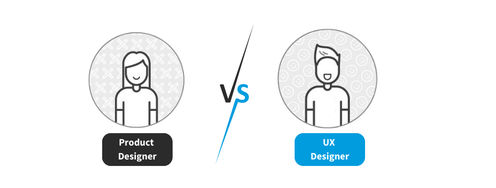
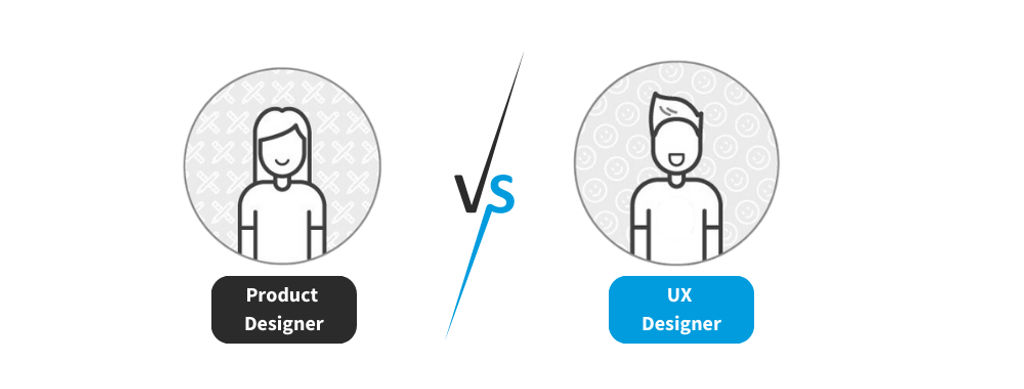
Product and user experience (UX) design are both prominent fields—and make rewarding career choices. People often use the two terms interchangeably in conversation, but they’re not the same. Product designer vs. UX designer isn’t a simple “either-or” scenario—and each role has got unique responsibil

Social shares
761
Published
Read Article
Read full article
How to Become a Product Manager: Best Career Advice - Article hero image
Interaction Design Foundation logo

How to Become a Product Manager: Best Career Advice

Pick any product and you’ll find that product management is vital to how successful it is—and product managers are who make sure that a product’s life cycle runs smoothly, and it means they know how to align strategy, vision, and user needs. Product managers split into multiple roles that have got u

Social shares
559
Published
Read Article

Product Design and UX Design Roles: Unveiling the Differences

Product Design and UX Design Roles: Unveiling the Differences

Product and user experience (UX) design are both prominent fields—and make rewarding career choices. People often use the two terms interchangeably in conversation, but they’re not the same. Product designer vs. UX designer isn’t a simple “either-or” scenario—and each role has got unique responsibilities and focal points that contribute in different ways to a brand’s end product. Stay tuned to find out the differences between a UX designer and a product designer so you know their roles, responsibilities, skills, tools, and more and see which might be a more compelling calling for you.

What is a Product Designer?

A product designer is someone who leads—or who’s part of—the team that creates a new product or makes an existing one better. They take care of the entire design process for that. A product designer is a professional who works in cross-functional teams to address technical constraints and ensure usability is well in place from ideation to production. The contribution they make to the overall product experience goes far beyond its visual appeal.

"Our role is to imagine products that don't exist and guide them to life." 

– Apple designer Christopher Stringer

Learn more about product design in our guide | What is Product Design?

What are Responsibilities and Job Duties of a Product Designer?

They translate their firm grasp of those needs into functional and appealing designs. However, it’s not a solo affair, as they collaborate with cross-functional teams to bring their designs to life and the best possible—or most improved—end product to show for it.

Product designers take on the task of understanding user needs and user behavior—which is why one of their main activities is to conduct user research and create user personas to understand their needs and motivations. A product designer might use interviews, surveys, questionnaires, diary studies, secondary market research data, or many other tools and resources to understand the users and the business context of the product they’re working on.

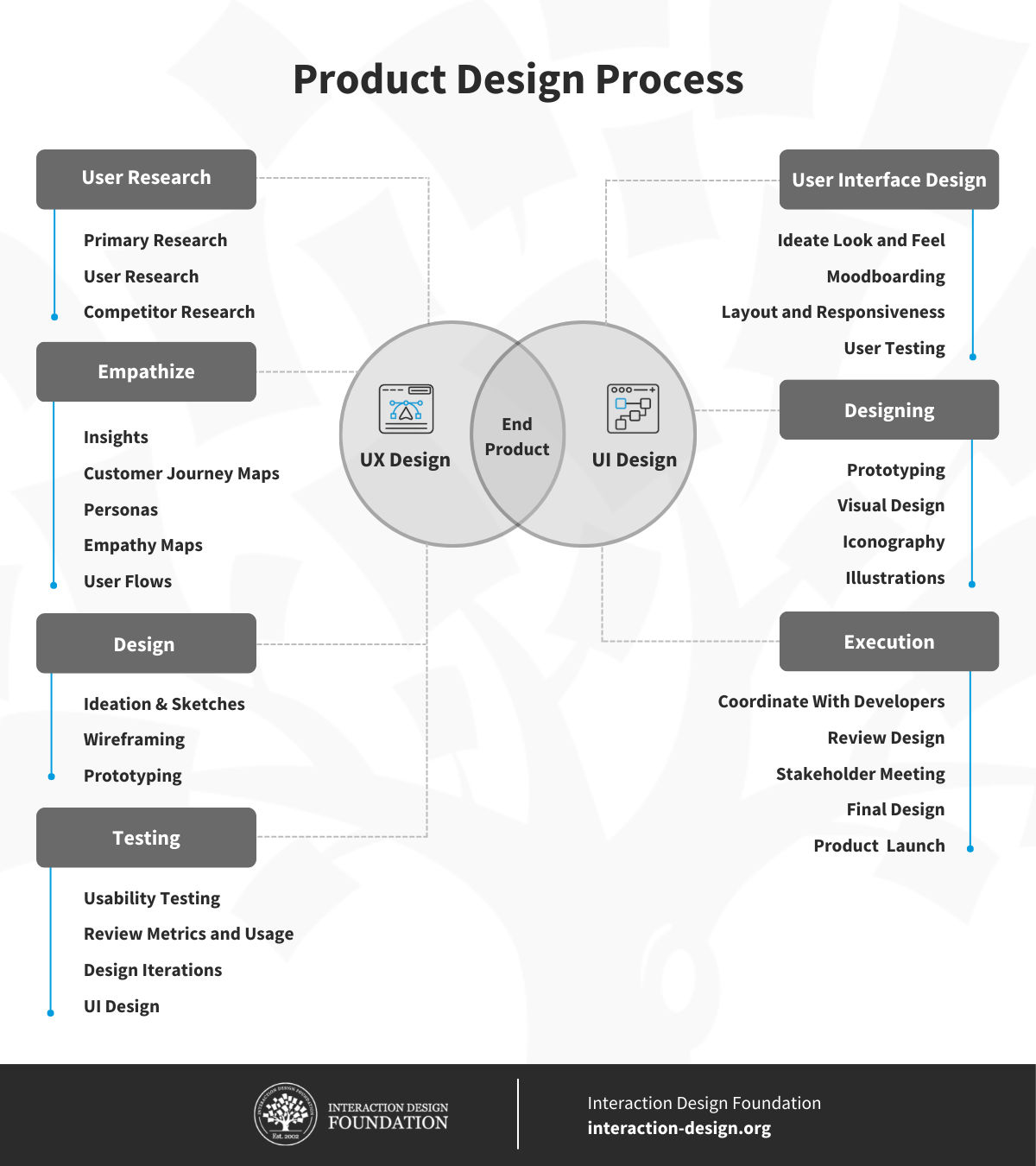
Product Design Process

© Interaction Design Foundation, CC BY-SA 4.0

Then, from that, they ideate and sketch design concepts based on insights they’ve gained from research. They can then move on to develop and test prototypes (starting with low-fidelity ones and then on to mid- and high-fidelity prototypes). After that, they’ll want to collect user feedback to see what’s right and wrong with the prototypes and from there refine designs. And once the prototype works best—or maybe that should be, the best prototype works best—product designers collaborate with developers, project managers, and other team members to implement their designs. It’s about a user-centered design approach—and the mission is always to make the best user experience possible for what the brand wants.

What are Key Skills and Qualifications for Product Designers to Succeed?

If you’re going to be a product designer, you’ll need a wide array of skills and qualifications to excel in the role—and the types of ones to have include:

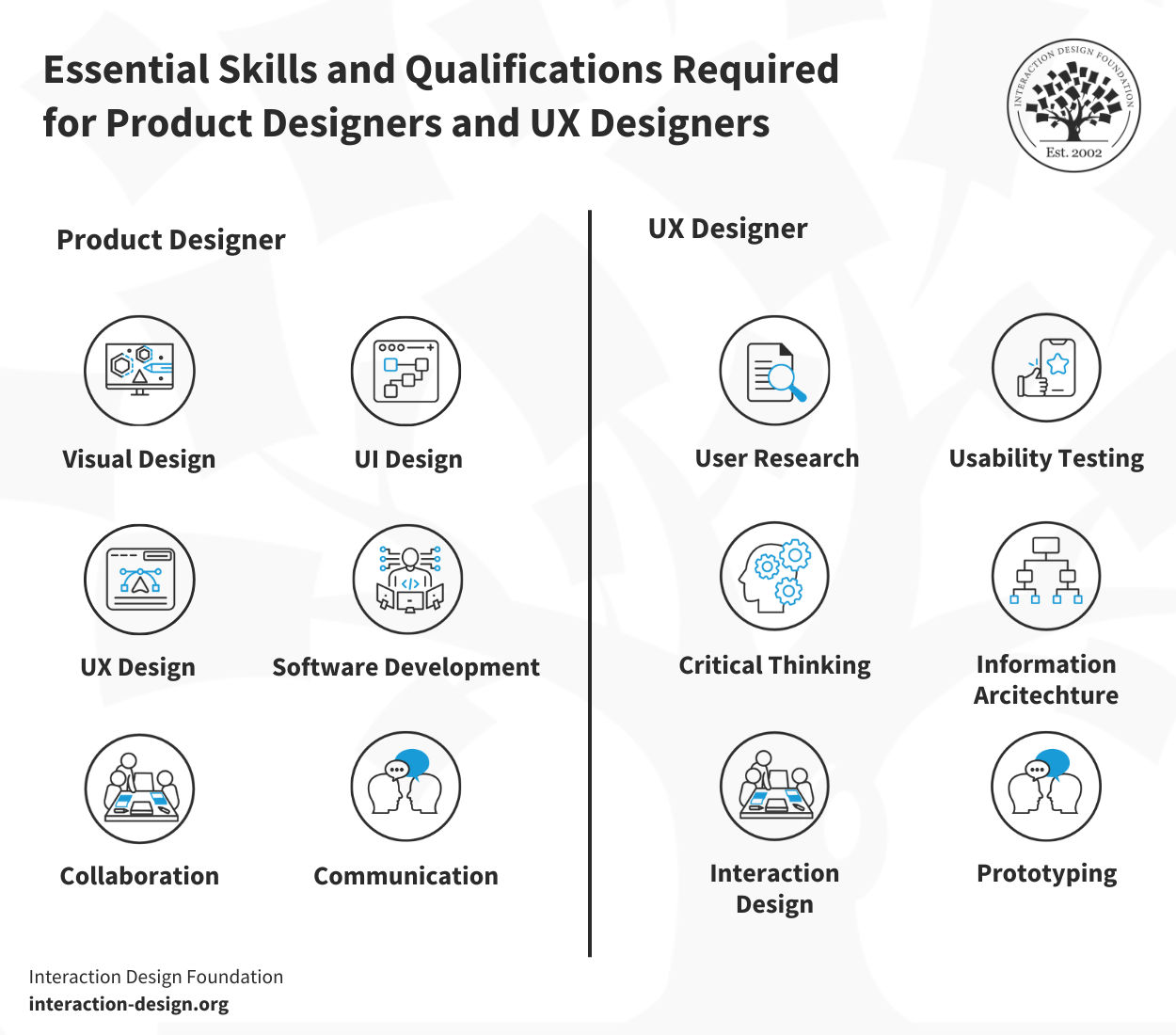
  1. Visual design is a big one, and it takes a good knowledge of elements of visual design—such as layout, color theory, imagery, and typography—to create aesthetically appealing products.

  1. UI design is up there, too (not that this list is in any order as such). Skills in creating interactive visuals and front-end development contribute to designing user-friendly interfaces.

  1. UX design is next—and it’s often confused with UI design. UX skills like prototyping, information architecture, and wireframing are things to have if you’re going to craft products that deliver a positive user experience.

  1. Prototyping is a critical one, and the ability to quickly create prototypes that are effective is going to serve you well. Prototypes allow designers to test concepts and general approaches to understanding if the design does meet business and user goals.

  1. User research—and effective research that includes planning, surveying methods, auditing, and all the joys of handling quantitative research and qualitative research data—is pivotal to understand user behavior and user needs.

  1. Communication may be a so-called soft skill, but you’ll want strong communication skills to facilitate task delegation, project completion on time, and a “watertight” understanding of client requirements.

  1. Teamwork is another one that seems to get corporate-buzzworded into overuse, but collaboration is vital in product design. It’s what nurtures the generation of solutions, understanding of project goals, and incorporation of diverse ideas.

  1. Problem-solving completes the “trilogy” of “corporate buzzwordy” attributes, but make no mistake—you’ll want strong skills here to find innovative solutions and identify and fix design errors.

  1. Attention to detail is in the “mix,” too, because a keen eye for detail ensures things line up with client guidelines and helps you spot areas that want—or scream for—design improvements.

  1. Creativity is a happy ingredient—you’ll probably be glad to hear. Innovation and creativity are integral parts when you need to generate fresh product ideas and interpret stakeholder information in ways that can “wow.”

  1. Empathy is all about the users—and rightly so, as empathy helps understand and address user needs effectively; and it’s what leads to—you guessed it—user-friendly products.

  1. Computing awareness—in that, while you don’t need coding skills as such, a broad knowledge of what’s involved on that side of things will help you envision how the product might get realized by the developers. What’s more, you’ll be able to liaise better with development team members from having that knowledge.


(Watch this video to learn more about Empathy and why it is crucial in product design.)

  1. Critical thinking: The ability to explore and test multiple design ideas and observe and improve design processes is more than a little valuable. You’ll need it to apply your user research in the most effective ways.

  1. Emotional intelligence is another “biggie,” as when you’ve got a high “EQ,” you can do wonders to meet—and exceed—user needs. Think about how it can enhance user engagement and experience when you design products that bring specific emotions out of your (brand's) users.

    These skills make you a proficient product designer and enhance your ability to create products that meet and exceed user needs.

What are Examples of Successful Product Designs and Their Impact?

Uber's product design shines with its Base design system—which makes functionality and visual consistency priorities. A standout feature is the one-handed design, a nifty thing that caters to on-the-go users. Key features are strategically located for easy reach for users. Flyout menus in the design enhance the experience, showcasing the profound influence of thoughtful product design.

Another compelling example is Medium. It excels in product design through its open writing platform—which makes for a nice and immersive reading and writing experience. Its minimalistic design—characterized by a clean white background—minimizes clutter and distractions. What's remarkable is its embodiment of polite design principles, carefully balancing user engagement with respect for the users’ time and attention. Notifications like subscription renewals subtly reinforce trust and respect for user choices.

What is a UX Designer?

A UX (user experience) designer focuses on enhancing user satisfaction by improving usability, accessibility, and interaction between the user and the product—and, by association, the brand behind the product. They focus on creating seamless and meaningful experiences that speak to users on all levels required for that “magic” to happen. Their work influences the entire process of acquiring and integrating the product—and that includes branding, design, usability, and function.

"There are three responses to a piece of design — yes, no, and WOW! Wow is the one to aim for."

Milton Glaser

What are Responsibilities and Job Duties of a UX Designer?

UX designers are the users’ advocates—not that product designers aren’t. “UXers” place the user at the center of the design process to ensure they meet their users’ needs and expectations in the design solution that comes out. Their responsibilities typically include the need to:

  • Understand and define user goals, motivations, and behaviors through user research.

  • Create user personas, journey maps, and wireframes to represent and guide the user experience.

  • Design the user interface layout and navigation flow.

  • Test design concepts and iterate based on user feedback and usability testing results.

  • Collaborate with UI designers, developers, and product managers, which will ensure the final product delivers a seamless user experience.

What are Key Skills and Qualifications for UX Designers to Succeed?

Essential Skills and Qualifications Required for Product Designers and UX Designers

© Interaction Design Foundation, CC BY-SA 4.0

  • Research is a massive one, and the ability to plan, conduct, and analyze user research is essential. It allows UX designers to understand their audience better and their needs, helping shape more effective design strategies.

  • Technical skills for prototyping, including familiarity with programming are up there, too. Although knowledge of actual programming in Java or JavaScript may not be required, it’s crucial to understand how live prototyping tools work.

  • UX design tools are vital to be familiar with—ones like Sketch and Figma—to create and adjust designs efficiently.

  • Information architecture (IA) is a big one, too, and organizing information in a user-friendly and intuitive way is key. This includes designing clear navigation systems, labeling, and search functions that make the product easy to use.

  • Wireframing skills such as creating wireframes, or blueprints, for each screen of an interface are important. They help to define the necessary elements for each page and how they will work, instead of focusing on aesthetic aspects.

  • Visual communication is vital, as in to be proficient in visual language. That may include an understanding of layout, color, typography, icons, images, and design theory.

  • Interaction design and user-centered design principles are important for UX designers, as they’ve got to understand the interaction and user-centered design principles strongly. These principles help designers create designs that facilitate a smooth user experience.

  • Problem-solving skills—while perhaps easy to overlook as something that “goes without saying,” excellent problem-solving skills help UX designers identify and overcome design challenges—the crux of their work.

  • Communication skills are another one that can be easy to overlook, but effective communication skills are vital to collaborate with various stakeholders and clearly explain design decisions.

You don’t always need a design degree to become a UX designer. Many people in this field come from different careers and have taught themselves or gone through intensive short-term programs known as boot camps.

Transcript

(Learn about the history of UX and what it means to be a UX designer.)

What are Examples of Exceptional UX Design in Websites or Digital Products?

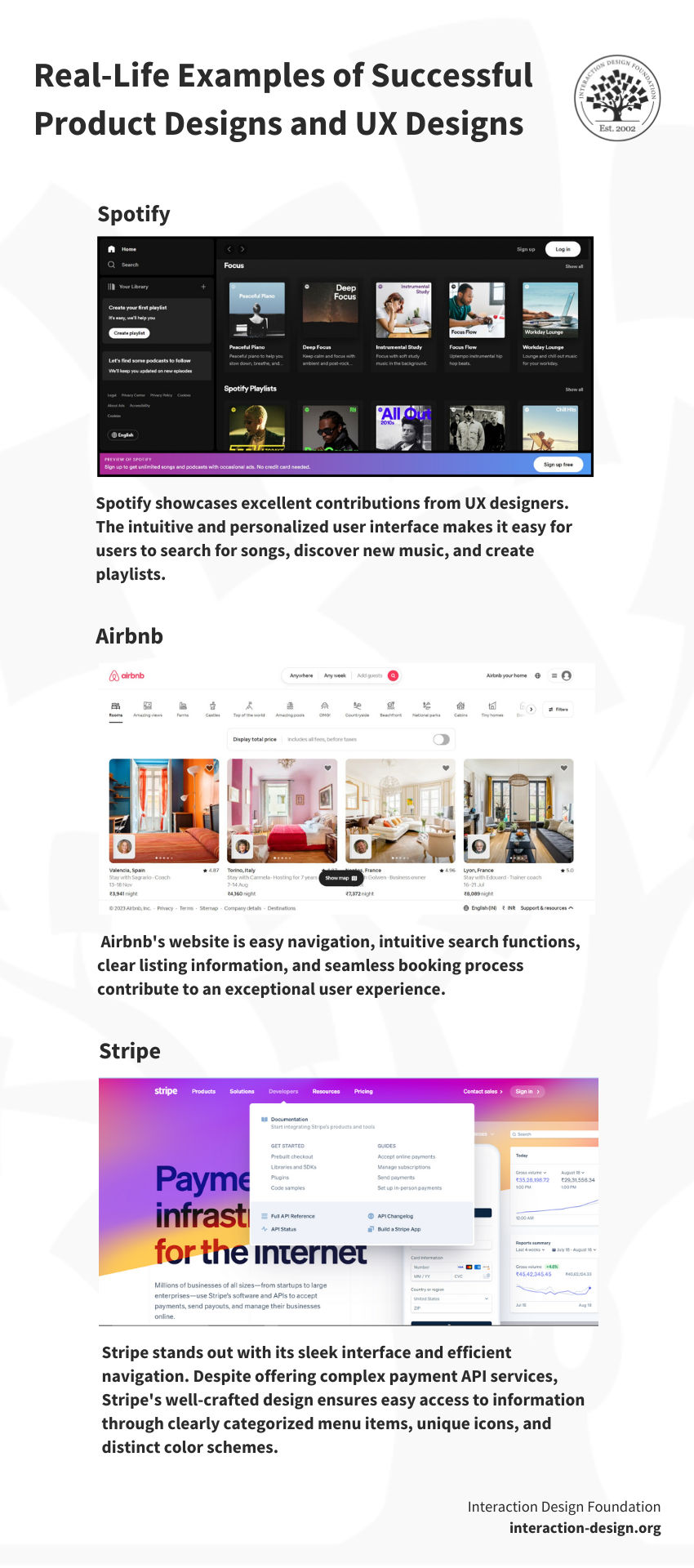
We encounter countless examples of effective UX design in our digital interactions. Airbnb's website is one such example. Its easy navigation, intuitive search functions, clear listing information, and seamless booking process contribute to an exceptional user experience.

Apple's website exemplifies superior UX design with its intuitive “compare products” feature. It presents a detailed comparison of selected items in a structured, easy-to-follow format. This tool streamlines online shopping and decision-making for users—and it shows that innovation and user support can greatly elevate the digital customer experience.

Real-Life Examples of Successful Product Designs and UX Designs

© Interaction Design Foundation, CC BY-SA 4.0

In both examples, the UX designers have excelled in understanding and meeting user needs, demonstrating UX design’s pivotal role in creating successful digital products.

What are The Differences Between Product Designers and UX Designers?

While product and UX design have a great deal in common, they’ve each got a unique focus that differentiates them. Let’s explore these roles more deeply, highlighting their similarities, differences, and exceptional contributions to the design process.

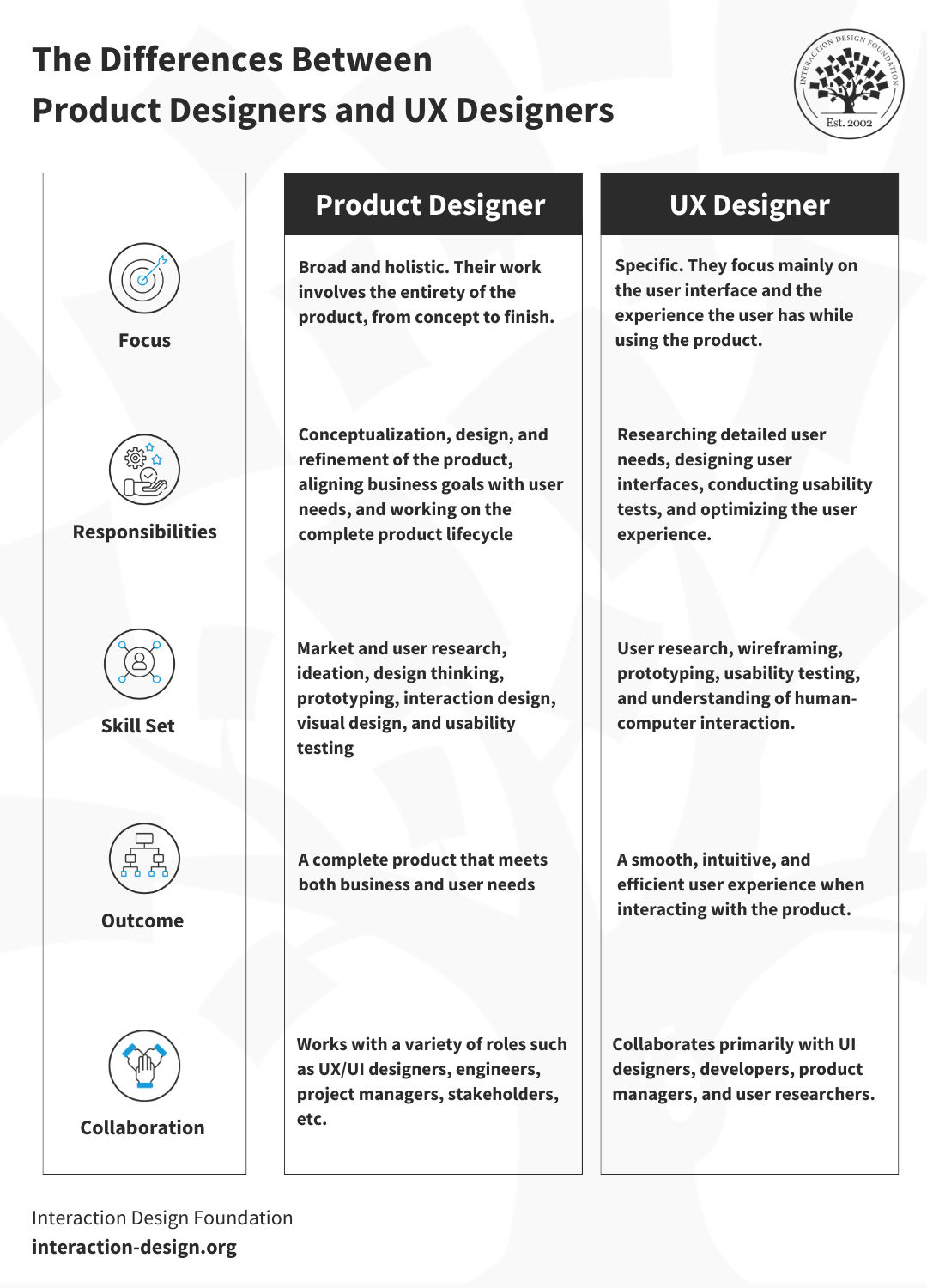
The Differences Between Product Designers and UX Designers

© Interaction Design Foundation, CC BY-SA 4.0

Here’s a table of differences between product designers and UX designers to give you a neat overview:

Product Designer

UX Designer

Focus

Broad and holistic. Their work involves the entirety of the product, from concept to finish. 

Specific. They focus mainly on the user interface and the experience the user has while using the product.

Responsibilities

Conceptualization, design, and refinement of the product, aligning business goals with user needs, and working on the complete product lifecycle

Researching detailed user needs, designing user interfaces, conducting usability tests, and optimizing the user experience

Skill Set

Market and user research, ideation, design thinking, prototyping, interaction design, visual design, and usability testing

User research, wireframing, prototyping, usability testing, and understanding of human-computer interaction

Outcome

A complete product that meets both business and user needs

A smooth, intuitive, and efficient user experience when interacting with the product

Collaboration

Works with a variety of roles such as UX/UI designers, engineers, project managers, stakeholders, etc.

Collaborates primarily with UI designers, developers, product managers, and user researchers

Product Designer Vs. UX Designer: Comparison of Job Roles 

To be sure, product designers and UX designers both work towards creating user-friendly and engaging designs, but their roles differ in terms of scope and focus.

A product designer guides a product through its entire lifecycle, and that goes from initial concept to final execution. However, their responsibilities aren’t confined to user experience (UX) and user interface (UI) design. They also consider business goals, market viability, and the product’s technical feasibility.

Meanwhile, a UX designer focuses primarily on the user experience. They research user behavior, create user personas, and design the interaction between the user and the product. They prioritize the user’s needs and emotions, and so they make sure the product is intuitive, satisfying, and enjoyable.

Distinct Areas of Focus and Expertise

Product design and UX design have distinct focus areas, too.

Product design: Product designers focus on the big picture. They strategize, brainstorm, and make crucial decisions about the product’s design and features. They consider various aspects of the product to deliver a complete package that fulfills the user's and the business's needs on point. These aspects may include aesthetics, functionality, and the overall business strategy.

UX design: UX designers are primarily concerned with the user’s experience. They have a deep understanding of the user’s needs, motivations, and behavior. They prototype and test designs to meet user expectations and create a seamless, enjoyable experience for all users.

Contributions to the Overall Design Process

Both roles contribute significantly to the overall design process—each in its own unique way.

A product designer tends to be involved from the initial concept to the final execution. They define the product’s direction, set design goals, and coordinate with different teams to ensure these goals are met.

A UX designer is involved from the get-go, from the very start of a project. They conduct user research, create user journeys, and test prototypes to identify and fix usability issues.

Learn more about the design process in this piece by the IxDF | Design Process

What are Real-Life Examples of Unique Contributions?

To understand the differences better, let’s consider a few examples.

Product designer: In product design, Stripe stands out with its sleek interface and efficient navigation. Despite offering complex payment API services, Stripe’s well-crafted website design ensures easy access to information through clearly categorized menu items, unique icons, and distinct color schemes. This focus on user-friendly navigation demonstrates the depth of a product designer’s role in creating a compelling, intuitive, and ultimately successful product.

UX designer: Spotify, the popular music streaming service, showcases excellent contributions from UX designers. The intuitive and personalized user interface makes it easy for users to search for songs, discover new music, and create playlists. The designers also conceived user-focused features such as Discover Weekly and Year in Review to enhance the overall experience and make Spotify a top choice for music enthusiasts.

The key in design is to know how these roles differ, and it helps put the right skills to use at the right time. Even though these roles do share some similarities, each has its own view and skills. Both of them bring a unique perspective and set of skills that contribute to creating a successful, user-friendly product.

The Interconnectedness of Roles

Despite their differences, the roles of product designers and UX designers are far from silos. In fact, there’s a significant amount of overlap and collaboration needed between the two. For example, a product designer’s decision about a feature will influence the user experience, and the UX designer’s research and testing can provide valuable insights into product development.

Skills and Qualifications

While both roles require a keen eye for design, the specific skills and qualifications differ.

Product designers: Product designers need a broad set of skills, including visual design, UI design, UX design, familiarity with software development, and an understanding of business and market strategy. They also need excellent problem-solving skills, the ability to think critically and make decisions, and strong communication skills to effectively collaborate with various stakeholders.

UX designers: UX designers need expertise in user research, usability testing, information architecture, interaction design, and prototyping. They must be empathetic to understand users’ needs, have strong problem-solving skills to improve the user experience, and be effective communicators to advocate for users’ needs.

The Impact on the End Product

Product and UX designers’ distinctive contributions greatly impact the end product.

Product designers: Product designers influence the product’s overall direction and functionality. Their decisions determine the product’s features, how it will look, and how it aligns with the company’s strategic goals and market needs.

UX designers: UX designers directly influence how users interact with the product at the same time as ensuring that business needs get met. Their work ensures the product is intuitive, enjoyable, and meets the users’ needs, influencing user satisfaction and loyalty.

While product designers and UX designers have distinct roles, they both play a critical role in creating a successful product. It’s a vital mix on a project, and using their unique skills and perspectives, they work together to create a product that meets business objectives and delivers a satisfying user experience.

Which One Should You Choose?

Choosing between a career in product design or UX design will depend a great deal on your interests, skills, and the kind of work you enjoy doing. Both roles can offer rewarding and lucrative career paths. Still, each requires a different set of skills and focuses on different aspects of the design process.

1. Product Designer Vs. UX Designer: Evaluating Interests and Skills

First, you’ll want to take stock of your interests and abilities. If you love to think big-picture and enjoy handling multiple aspects of a product, this might be a sign that you’re suited for product design. What’s more, if you want to get involved in the entire product lifecycle—from conceptualization to market release—then product design could be the right choice for you. This role calls for a solid understanding of technology, user interface design, market trends, and strong problem-solving and leadership skills.

On the other hand, if you’re drawn to understanding user behavior, conducting research, and creating intuitive and engaging user interfaces, then UX design might be more suitable. UX designers often need strong empathy, analytical thinking, and skills in user research, along with proficiency in using UX design tools and creating wireframes and prototypes.

2. Product Designer Vs. UX Designer: Career Paths and Opportunities

Both fields offer significant opportunities for career growth. As a product designer, you can advance to senior roles, lead design teams, or even become a product manager. Product designers often find opportunities in tech companies, design agencies, and startups.

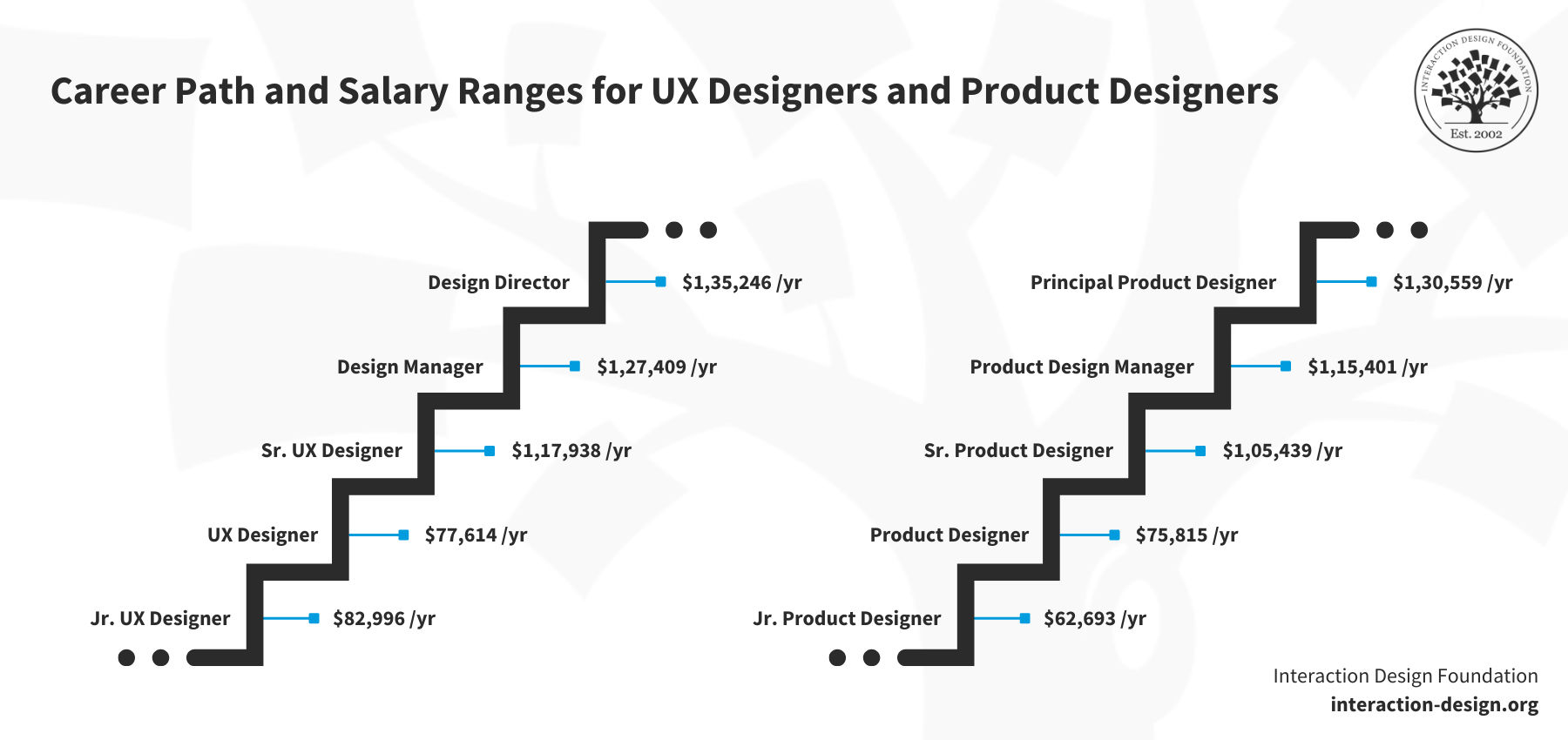
Product designer salary - $76,421/year

Career Path and Salary Ranges for UX Designers and Product Designers

© Interaction Design Foundation, CC BY-SA 4.0

In the field of UX design, you can progress to senior UX designer, UX manager, or UX strategist roles. UX designers are in high demand in industries like tech, e-commerce, digital marketing agencies, and any business with a strong digital presence.

UX designer salary - $95,587/year

Learn more about the different UX roles in this piece | The Ultimate Guide to Understanding UX Roles and Which One You Should Go For

3. Product Designer Vs. UX Designer: Personal Preferences and Aptitude

Consider what you value most in a job. Product design might be the right choice if you like having varied responsibilities and directly impacting a product’s end result. However, if you prefer to specialize in creating optimal user experiences and working closely with user data and feedback, UX design could be a better fit for you.

Last, but not least, consider where your natural aptitudes lie. Do you have a knack for aesthetics, technology, and overseeing projects? You might excel in product design. But you might find your calling in UX design if you’re a strong communicator with an analytical mind and a passion for understanding and improving user experiences.

4. Product Designer Vs. UX Designer: Making an Informed Decision

Before you decide, it can be a good idea to gain some practical experience. Try taking online courses or participating in design challenges to get a feel for each role. Speak to professionals in both fields to understand their day-to-day work and their challenges to make an informed decision based on a realistic understanding of what each job entails.

Remember, there’s no one-size-fits-all answer—it’s about finding the role that aligns best with your interests, skills, and career aspirations. Whichever path you choose, both product design and UX design are exciting fields with the potential to shape the future of technology.

The Take Away

Understanding the differences between product designers and UX designers is crucial, whether you’re an aspiring designer, a hiring manager, or interested in the field. Product designers focus on the overall product, and they integrate multiple facets from concept to market. In contrast, UX designers hone in on the user experience to make products intuitive, enjoyable, and user-friendly.

Consider your interests, skills, and long-term goals when you’re choosing a career. Both fields offer rewarding career opportunities, but they each require a unique set of skills and focus. You can gain a deeper understanding of these roles to make an informed decision that aligns with your career aspirations.

Are you ready to kick-start your journey in design? Upskill for your next role with our intermediate courses, or if you're new to the field, join our beginner UX courses today! Let's embark on this exciting journey together!

Feel Stuck?
Want Better Job Options?

AI is replacing jobs everywhere, yet design jobs are booming with a projected 45% job growth. With design skills, you can create products and services people love. More love means more impact and greater salary potential.

At IxDF, we help you from your first course to your next job, all in one place.

See How Design Skills Turn Into Job Options
Privacy Settings
By using this site, you accept our Cookie Policy and Terms of Use.
Customize
Accept all

Be the One Who Inspires

People remember who shares great ideas.

Share on:

Academic Credibility — On Autopilot

Don't waste time googling citation formats. Just copy, paste and look legit in seconds.