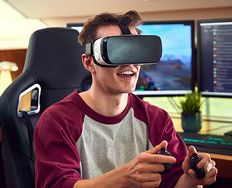
Haptic interfaces enable people to interact with computers using force feedback and vibrations to simulate tactile sensations like texture and movement. These sensations are created by applying forces or vibrations to the user's skin, which can mimic the feel of touching natural objects.
Explore how haptics work for designs and users, in this video with Alan Dix: Author of the bestselling book “Human-Computer Interaction” and Director of the Computational Foundry at Swansea University.
Haptic interfaces have applications in various fields, from gaming to medicine. For example, they can give surgeons better control when performing delicate operations or give gamers an immersive experience. They can also help people with disabilities interact with computers in ways that were not previously possible.
A Comparative Analysis of Haptic Feedback Technologies
Various types of haptic feedback exist to simulate tactile sensations, and each type has its strengths and weaknesses. The effectiveness of haptic feedback depends on the context in which it is used. Here's a comparison of different kinds of haptic feedback and their effectiveness in different contexts:
Vibration Feedback: Vibration feedback is the most common type of haptic feedback used in digital devices. It uses small motors or actuators to create vibrations that mimic real-world sensations. Vibration feedback provides simple alerts or notifications, such as when receiving a text message or an email. However, vibration feedback has limitations regarding more complex interactions; for example, it cannot provide precise force information, making it less effective for tasks that require fine motor control or manipulation.
Force Feedback: Force feedback gives users a sense of resistance or pressure when they interact with digital objects. It uses motors or other mechanisms to apply forces to the user's skin, simulating the sensation of touching natural things. Force feedback benefits applications that require precise control over physical interactions, such as surgery simulation and virtual assembly training. In these contexts, force feedback can help trainees develop muscle memory and improve performance.
Tactile Feedback: Tactile feedback provides a sense of texture and surface properties. It uses arrays of small pins or other mechanisms to create patterns on the user's skin, simulating the sensation of touching different textures. Tactile feedback is helpful for applications where surface properties are essential, such as product design and prototyping. It can also enhance the realism of VR/AR experiences.
The choice between different types of haptic feedback depends on the specific application and user needs. Other types may be necessary to create a fully immersive and realistic experience.
Examples of Haptic Interfaces in Real-World Applications
Haptic interfaces have a wide range of applications in various industries. They are used in gaming, virtual reality, healthcare, automotive, and many other fields to improve the overall experience and create a more immersive environment.
In the automotive industry, haptic feedback can alert drivers of potential hazards on the road, such as lane departure or collision avoidance systems. This technology provides tactile feedback through vibrations or pressure changes in the steering wheel or seat to help drivers avoid accidents.
In healthcare, haptic devices are used for surgical training and simulators. These devices provide realistic touch sensations to trainees, enabling them to develop their skills without putting actual patients at risk.
In gaming and virtual reality, haptic feedback can simulate physical sensations like touch, texture, and temperature.
How to Enhance User Experience in VR/AR with Haptic Feedback
Haptic feedback is essential to virtual reality (VR) and augmented reality (AR) environments. It adds a new dimension to the user's experience by providing tactile sensations that mimic real-world interactions. For example, when you touch a virtual object, haptic feedback can simulate the feeling of its texture, weight, and shape.
Moreover, haptic feedback can help users navigate complex environments more efficiently. In VR/AR simulations with no physical reference point for orientation, haptic feedback can provide subtle cues to guide users through their surroundings. For instance, it can indicate the direction of movement or warn users about obstacles in their path.
Ultrasound Haptics: The Future of Tactile Simulation
Ultrasound haptics enables the creation of tactile sensations in mid-air using ultrasonic waves. Focused ultrasonic waves exert pressure on the skin, creating a sense of touch without requiring users to wear gloves or hold on to physical devices. This technology could guide surgeons during delicate procedures or enhance immersion in virtual environments. While still in its early stages, ultrasound haptics could revolutionize how we interact with digital devices and the world around us.