Affective Computing

Your constantly-updated definition of Affective Computing and collection of videos and articles.
Be a conversation starter: Share this page and inspire others!

394 Shares

What is Affective Computing?

Transcript

Affective computing is the expanding intersection between technology and emotion. It is characterized by the detection of and response to human feelings.

The term Affective Computing originates in the 1990s with Rosalind Picard's paper and book of that title. Picard takes a broad view of the field and includes several far-reaching philosophical and technical issues. Not surprisingly, there are significant ethical issues too. For example, if a system can detect your emotional state, how widely should that information be available? Does it belong to you? Some issues are like those with facial recognition, which is still very controversial.

Practical Applications of Affective Computing

Affective computing is alive and well, albeit nascent. It has promising applications in problem domains where face-to-face contact is less available. Remote learning and healthcare are two areas where responding to users’ emotional states could considerably enhance the effectiveness of interactions. With an aging population and severe shortages of trained staff, healthcare may be a vital problem domain for the burgeoning field of applied affective computing (AAC).

As the name suggests, AAC focuses on the practical aspects of detecting and responding to human emotions. It is a complex mix of “psychology, AI, Human-Computer Interaction (HCI), robotics, engineering, social science, and medical science.” (See Applied Affective Computing below.) Artificial Intelligence, in particular, has an increasingly vital role, but effective sensors and algorithms for identifying emotions are also needed. Facial responses are critical for many emotions and feature detection, as illustrated below, is a necessary stepping stone.
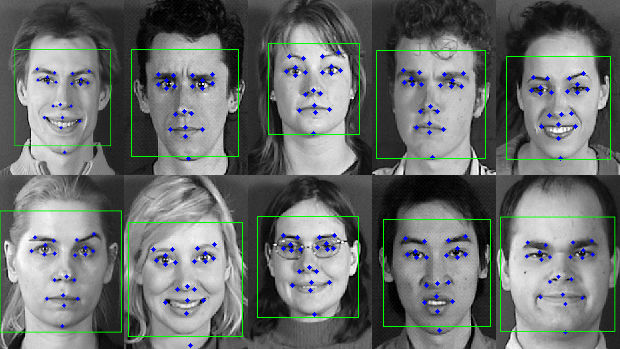
Image of faces with eyes, nose and mouth features highlighted by computer

Detection of Static Geometric Facial Features

Intelligent Behaviour Understanding Group (iBUG), Department of Computing, Imperial College London. Fair Use.

AAC promises to be an exciting field. Although the name itself was coined only in the late 2010s, AAC systems already perform better than humans in recognizing some emotions, especially in audio-visual emotion classification.

Emotions

Human emotions are central to affective computing. Charles Darwin was one of the earliest authors on emotions. He was instrumental in their study through his 1872 book, The Expression of the Emotions in Man and Animals. Paul Ekman, among others, credits Darwin for being the creator of modern psychology. Ekman was responsible for the “big-6” model of basic emotion theory later in the 20th century, identifying them as:

  • Fear

  • Anger

  • Joy

  • Sadness

  • Disgust

  • Surprise

Darwin’s universality hypothesis proposed that all humans convey these emotions through facial expressions, but recent evidence shows this is not necessarily true (see Jack et al. in the references below). Further study in this area has resulted in a cross-cultural expression model:
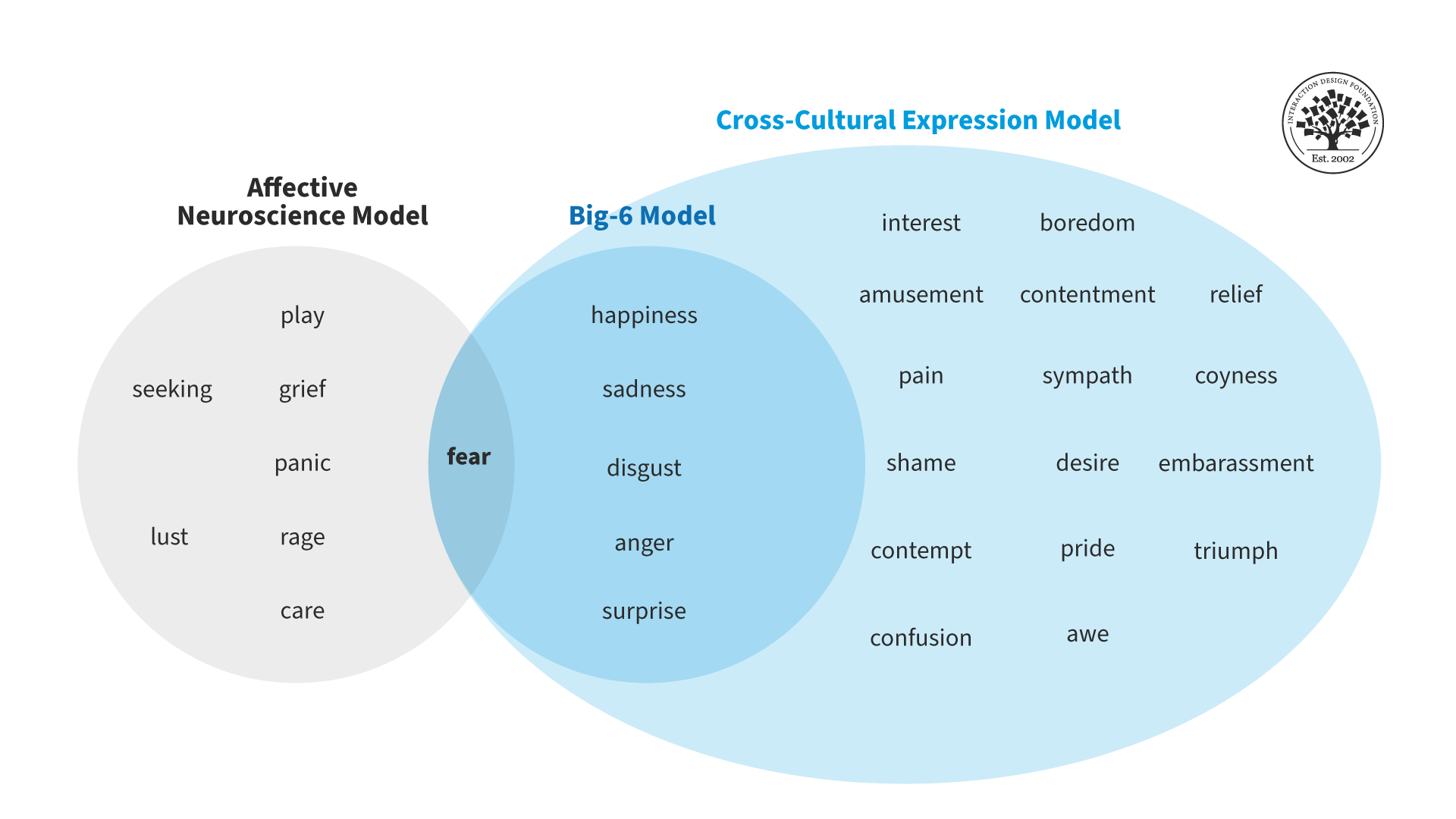
Adapted from Applied Affective Computing, Tian et al.

Adapted from Applied Affective Computing, Tian et al.

On the technical side, it may be some time before we can develop fully emotion-aware systems. Psychologists divide emotions into two categories. Primary emotions are basic “animal” responses from our primitive brains (the brain stem and limbic system). These are alarm responses that lead to immediate physiological reactions. They can be readily detected. Secondary emotions are more considered and potentially complex. Some authors suggest that they ultimately produce physiological responses, but others disagree. There are doubts that secondary emotions can be detected, particularly in identifying mixed emotions and their component causes. For example, you might be sad that a pet has died but relieved that it is no longer suffering. (See the Sloman and Damasio references below.)


Questions About Affective Computing?
We've Got Answers!

Why is healthcare a significant area for affective computing?

Due to an aging population and a shortage of trained healthcare staff, affective computing can be beneficial in healthcare by improving emotional understanding and responses in remote care settings.

Can affective computing systems detect all emotions?

Currently, affective computing systems can effectively recognize some primary emotions, but detecting complex secondary emotions remains challenging.

What emotions are included in the "big-6" model by Paul Ekman?

The "big-6" emotions are fear, anger, joy, sadness, disgust, and surprise.

What are primary and secondary emotions?

Primary emotions are basic, instinctive responses from the brain's primitive areas, while secondary emotions are more complex and involve deeper cognitive processing.

Why is artificial intelligence important in affective computing?

Artificial Intelligence plays a vital role in affective computing by providing the necessary algorithms for detecting and responding to human emotions.

What is Applied Affective Computing (AAC)?

Applied Affective Computing focuses on the practical aspects of detecting and responding to human emotions, combining fields like psychology, AI, HCI, robotics, and medical science.

What are the practical applications of affective computing?

Affective computing has applications in remote learning and healthcare, where understanding emotional states can enhance interaction quality, especially in areas lacking face-to-face contact.

What are some ethical concerns with affective computing?

Ethical concerns include issues like privacy—how widely emotional data should be shared and who owns that information, similar to concerns around facial recognition technology.

Who coined the term "Affective Computing"?

The term was coined by Rosalind Picard in the 1990s in her paper and book titled "Affective Computing."

What is affective computing?

Affective computing is the intersection between technology and human emotions, characterized by detecting and responding to human feelings.

Earn a Gift Earn a Gift, Answer a Short Quiz!

1
2
3
4
1
2
3
4
Question 1
Question 2
Question 3
Get Your Gift
Interaction Design Foundation logo

Question 1

What is a major ethical concern in affective computing?

1 point towards your gift

  • How to improve the accuracy of emotion detection
  • How to integrate affective computing with other technologies
  • How to manage the ownership and privacy of emotional data
Interaction Design Foundation logo

Question 2

Which field significantly benefits from affective computing?

1 point towards your gift

  • Agriculture
  • Construction
  • Remote learning
Interaction Design Foundation logo

Question 3

Which disciplines can we see applied in affective computing?

1 point towards your gift

  • Astronomy, chemistry and computer programming
  • Biology, geography and history
  • Psychology, AI and human-computer interaction (HCI)

Learn More About Affective Computing

Make learning as easy as watching Netflix: Learn more about Affective Computing by taking the online IxDF Course Design for Thought and Emotion.

Why? Because design skills make you valuable. In any job. Any industry.

In This Course, You'll

  • Get excited as you create products and experiences that go beyond functionality to connect deeply with people. You'll discover how people think, act, and feel, and learn to design products and services they don't just use, but love. More love, more impact, greater salary potential. The principles of thought and emotion in design are not industry-specific, they're about people. Whether you work in healthcare, gaming, education, or finance, skills in human-centered design empower you to create products, services, and experiences people trust and are eager to share. As AI accelerates how fast we build and iterate, your timeless human-centered skills become even more powerful. You'll direct AI with deep human insight, and ensure outcomes remain meaningful, ethical, and genuinely resonate with people. This is how you stay in demand: Human-centered design skills transform AI from a tool into your new superpower.

  • Make yourself invaluable by mastering the psychology of thought and emotion to design experiences that make a real impact and convert. Studies show that companies that increased their human-centered design spending saw a lower cost of acquisition (74%), increased retention (79%), and increased market share (95%). You'll bring down high bounce and drop-off rates once you understand how people think and feel. You'll design intuitive experiences and products people care about and want to come back to. You'll know what drives people's decisions and turn frustrating interactions into joyful ones. Stand out as someone who creates measurable business success with solutions people love and advocate for. 

  • Gain confidence and credibility as you build a portfolio that impresses employers, clients, and hiring managers. Apply your new skills immediately with downloadable templates like the Hierarchy of User Experience Needs, which empower you to transform existing technology or services into solutions that deliver a peak emotional experience. It's easier than you think! Even if you're new to design, you can effortlessly master Design for Thought and Emotion. If you complete the optional hands-on exercises, you'll walk away with polished, portfolio-ready case studies that showcase your new skills. You'll analyze enjoyable and frustrating interfaces, conduct casual user research, and create niche personas. You'll become familiar with thought-to-action pathways and design intuitive, effortless systems people love.

It's Easy to Fast-Track Your Career with the World's Best Experts

Master complex skills effortlessly with proven best practices and toolkits directly from the world's top design experts. Meet your expert for this course:

  • Alan Dix: Author of the bestselling book “Human-Computer Interaction” and Director of the Computational Foundry at Swansea University.

Get an Industry-Recognized IxDF Course Certificate

Increase your credibility, salary potential and job opportunities by showing credible evidence of your skills.

IxDF Course Certificates set the industry gold standard. Add them to your LinkedIn profile, resumé, and job applications.

Course Certificate Example

Be in distinguished company, alongside industry leaders who train their teams with the IxDF and trust IxDF Course Certificates.

Our clients: IBM, HP, Adobe, GE, Accenture, Allianz, Phillips, Deezer, Capgemin, Mcafee, SAP, Telenor, Cigna, British Parliament, State of New York

All Free IxDF Articles on Affective Computing

Read full article
How Emotions Impact Cognition - Article hero image
Interaction Design Foundation logo

How Emotions Impact Cognition

Two information-processing systems determine the human emotional response: the affective and cognitive processing systems. The affective system operates outside of conscious thought and is reactive, in that a series of psychophysiological events are initiated automatically following the receipt of s

Social shares
846
Published
Read Article
Read full article
Affect and Design - Article hero image
Interaction Design Foundation logo

Affect and Design

“...we now have evidence that aesthetically pleasing objects enable you to work better...products and systems that make you feel good are easier to deal with and produce more harmonious results. When you wash and polish your car, doesn't it drive better? When you bathe and dress up in clean, fancy c

Social shares
566
Published
Read Article
Read full article
Emotion in the Home - Article hero image
Interaction Design Foundation logo

Emotion in the Home

Technology is rapidly advancing and alongside comes a new way of understanding and approaching emotion in our homes. From the use of ambient color and smart lighting to wearable technology and scent-based systems, the relationship between technology and emotion is evolving.This relationship is still

Social shares
383
Published
Read Article

Emotion in the Home

Emotion in the Home

Technology is rapidly advancing and alongside comes a new way of understanding and approaching emotion in our homes. From the use of ambient color and smart lighting to wearable technology and scent-based systems, the relationship between technology and emotion is evolving.

This relationship is still in its early days, though. Scented candles, soft lighting and a wood fire are the traditional devices for trying to create relaxing, exciting or alluring moods in the home. Not surprisingly, technological replacements for some of these are becoming more sophisticated. In this short clip, HCI Professor Alan Dix talks about emotion in the home and beyond, into the interesting concept of remote intimacy.

Transcript

While the InTouch rollers, shown below, never surfaced as a consumer product, remote touch is increasingly prevalent in more intimate settings. For an example, see the link to Fundawear under references below.

Two sets of rollers that respond and show touch remotely.

InTouch Rollers

© MIT Tangible Media Group, Fair Use

Alan also mentioned Philips' Ambilight. This is a popular product that adds "intelligent" backlighting to the rear of flat panel TVs and monitors. The idea is to extend the visual experience of whatever is being viewed on the screen to the wall behind. For example, if the scene is of a brightly lit spring meadow, the wall behind would be filled with green. Manufacturers are increasingly offering this as a feature of flat panel displays, including gaming monitors. This intelligent backlighting can also be retrofitted with LED strips to the reverse of displays. The more sophisticated versions include a camera that faces the screen so that the image being shown can be processed to determine what should be displayed by the backlights. Typically, colors toward the edges of the screen are extended onto the wall behind.

Example of Philips Ambibight illuminating wall behind.

Philips OLED flat panel display with Ambilight backlighting

© Philips, Fair Use

The Take Away

Technology has become more emotional—in fact, it’s being designed to evoke emotion. In domestic environments, we’ve seen the introduction of ambient color, smart lighting, and other products that promote feelings of calm and pleasure. In the realm of remote intimacy, the focus is on systems that transmit emotional content between individuals, rather than attempting to elicit particular emotions. Developers have created wearable and ubiquitous technology devices to foster a sense of closeness, such as devices that enable people to touch or smell each other from afar. While this technology hasn’t passed the research phase, there is a lot of potential in this area to promote remote intimacy and maintain long-distance relationships.

References and Where to Learn More

●       Fundawear

Feel Stuck?
Want Better Job Options?

AI is replacing jobs everywhere, yet design jobs are booming with a projected 45% job growth. With design skills, you can create products and services people love. More love means more impact and greater salary potential.

At IxDF, we help you from your first course to your next job, all in one place.

See How Design Skills Turn Into Job Options
Privacy Settings
By using this site, you accept our Cookie Policy and Terms of Use.
Customize
Accept all

Be the One Who Inspires

People remember who shares great ideas.

Share on:

Academic Credibility — On Autopilot

Don't waste time googling citation formats. Just copy, paste and look legit in seconds.