How to Design Ethically: Expert Advice from Guthrie Weinschenk

by Kasturika Kasturika • 7 min read

542 Shares

As UX designers, we wield immense power to influence our users’ lives. We have the dual responsibility of catering to the interests of our users, as well as that of our sponsors (employers, clients and other business stakeholders). This can sometimes put designers in uncomfortable situations and raise questions about the ethical implications of our work.

From social messaging platforms and games that bombard users with notifications and advertisements, to applications that analyze every aspect of users’ lives to suggest their next workout routine, connect them with people they might have known in the past, or recommend the next news story to read — at what point do digital applications go from convenient, to mildly annoying, to unethical, to downright harmful?

To understand how we can evaluate our work from an ethical perspective and design more responsibly, we interviewed Guthrie Weinschenk.

Guthrie Weinschenk is a Behavioral Economist, Attorney and the COO of The Team W, Inc. He is the host of the podcast Human Tech, and author of I Love You, Now Read This Book. (It's About Human Decision Making and Behavioral Economics).

Here’s what Guthrie had to say about ethics in design (interview lightly edited for clarity).

1. What was your first ever design-oriented role?

This takes me back to another life! I was working for BP on their safety and risk management audit team. We designed audits both on paper and in person (of factories) to assess and reduce risk. The thought on the team was that less risk = less lost money. Our team was strongly trying to promote this mindset throughout the organization but I’m not sure how well it caught on. Of course, the spill in the gulf happened the next year.

2. What prompted you to focus on ethics in design?

It’s always been fun to think and talk about ethics. I took ethics and philosophy courses as an undergrad, and of course when you get to law school that is a large component. When you take the bar, there is an entirely separate test only to determine whether you will be an ethical attorney. So I’ve always been thinking about these issues and I knew they were important. But who would want to hear anyone talk about ethics? Well now everyone wants to, which has been great to see; especially in the design, UX, and behavioral science spaces. So I’ve always been thinking and talking about these issues, but now they are popular enough that I can make them a focus.

3. What are the 3 most common design decisions/patterns that you see in the wild or in your work, that are unethical and designers should be wary of?

I want to first say that if something is unethical is very context-dependent, so there usually isn’t a right or wrong answer in a vacuum. The classic example is “Thou shall not kill” which is straightforward enough, but what if it is in self-defense? The situation and context matter. That said:

  1. Ads that grab attention with fear/screams/jump scares.
  2. Hyper “addictive” games that use micro-transactions/loot boxes to make money.
  3. Hiding the phone number at websites to reduce call center volume.

4. What advice would you give to designers to navigate a scenario where they are asked to implement unethical business decisions by their clients/bosses?

  1. Express and voice your concerns. Try to recruit others to agree.
  2. Make an ROI argument against such behaviors. Maybe in the short term that will be profitable, but in the long term that may make your customers dislike your brand.
  3. Try and soften the worst of the unethical effects. There are small features and tweaks to help negate the worst of the effects while hitting most of the business goals.
  4. Work on creating structures and groups within your organization to argue against such behavior (the way in years past LGBTQ+ organizations became an instrument to normalize and support the LGBTQ+ community within an organization for example).
  5. Acceptance that those are the priorities of the organization you work for. I don’t think you will be a bad person for working for a company that only cares about maximizing profit above all else. You have a career and your finances to take into consideration as well. But at least you know the priorities of your organization.

5. How do you see the role of ethics in UX design evolving in the next 5–10 years?

Hard to say. I could see it becoming a significant part of the UX role, or I could see this being a nice fad that people give lip service to, but not being that important in the day-to-day.

6. What simple steps can designers take to evaluate the ethical implications of their decisions?

  • Accept you are only a cog in the machine.
  • Don’t be discouraged if you can’t do everything right all the time.
  • Focus on the worst offenders.
  • Watch my keynote about calculating ethics.
  • Use common sense. If you’ve created a Las Vegas-style slot machine to keep people habituated and paying money… Don’t be surprised at the outcomes.

7. As technology risks becoming more invasive, what is the one thing that keeps you up at night, and one thing that gives you hope about the use of these technologies?

What keeps me up: A.I. becoming perfect at tailoring stimulation for each individual.

What gives me hope: A recognition of these patterns and behaviors in the general public, and a dislike of them.
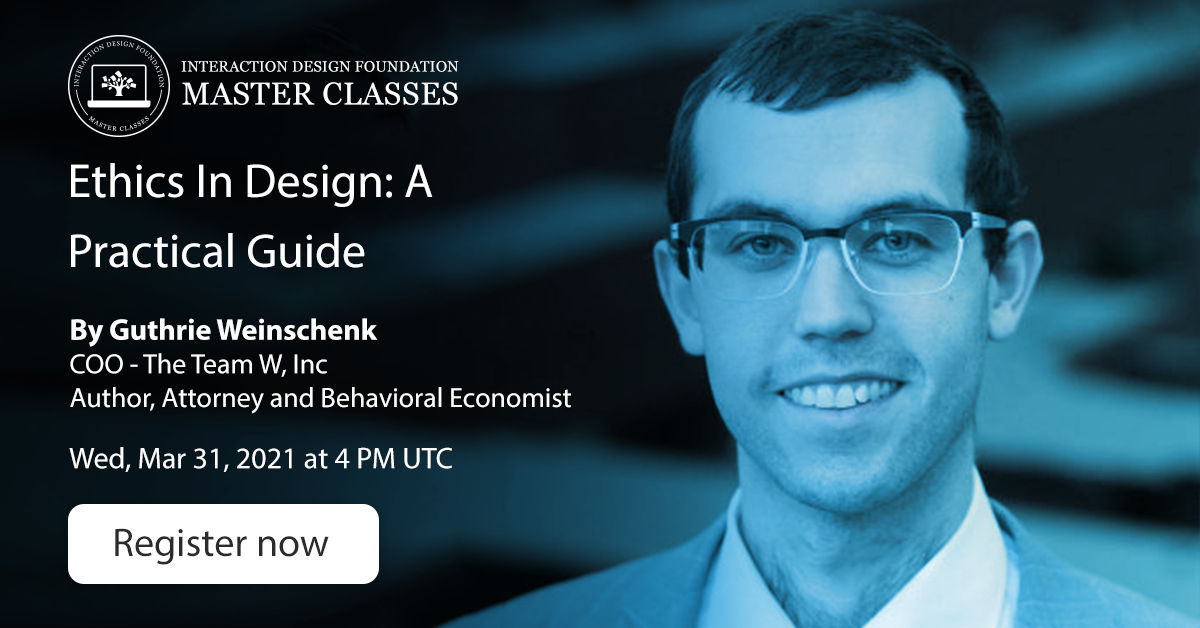
'Webinar Ethics in Design' by Guthrie Weinschenk on 31 March 2021 at 4PM UTC

In our work as UX designers, we owe it to our users and society at large to design ethically. Easier said than done. In practice, it can be very challenging to grasp the ethical dimensions of our work. What appears perfectly reasonable and justifiable to business stakeholders can be morally questionable from the users’ perspective.

In his Master Class, Ethics in Design: A Practical Guide, Guthrie Weinschenk will teach you how you can evaluate your work from an ethical perspective, and how to steer clear of unethical design practices as much as possible. Tune in live for the chance to ask your questions at the end of the keynote. Even if you cannot attend it live, register to get access to a recording to watch anytime afterward!
Topics in This Article

Learn More in This Course:

AI for Designers

10 days
16 % booked
View Course

What You Should Read Next

  • Read full article
    How to Build a UX/UI Design PDF Portfolio That Hiring Managers Will Love (Includes Examples) - Article hero image
    Interaction Design Foundation logo

    How to Build a UX/UI Design PDF Portfolio That Hiring Managers Will Love (Includes Examples)

    If you already have an online UX/UI design portfolio, do you need a PDF version? The answer is – yes; it is better to be safe than sorry! Some hiring managers like to see a more detailed PDF portfolio after reviewing your online portfolio, while some job applications may request an upload instead of

    Social shares
    943
    Published
    Read Article
  • Read full article
    UI & UX Designer Salaries: How Much Can I Earn in 2026? - Article hero image
    Interaction Design Foundation logo

    UI & UX Designer Salaries: How Much Can I Earn in 2026?

    How much can you earn as a UI or UX designer in 2026? The truth is that there's no single answer. Your earning potential depends less on averages and more on factors you can actually control. Designers using AI to accelerate execution while bringing strategic thinking, user empathy, and measurable b

    Social shares
    943
    Published
    Read Article
  • Read full article
    What Should a UX Design Portfolio Contain? - Article hero image
    Interaction Design Foundation logo

    What Should a UX Design Portfolio Contain?

    Your UX design portfolio is the key that gets you a job interview, and it is therefore vital that you include everything necessary in it. After all, a recruiter spends only a few minutes to form an opinion of you through your portfolio. If you’re new to UX, however, you might not know what exactly n

    Social shares
    825
    Published
    Read Article
  • Read full article
    What Tech Job is Right for Me? A Comprehensive Guide to Navigating Your Career Path - Article hero image
    Interaction Design Foundation logo

    What Tech Job is Right for Me? A Comprehensive Guide to Navigating Your Career Path

    Think about which tech career is right for you and you may well find that choosing a career is about getting work that offers fulfilling employment, personal growth opportunities, and—of course—good remuneration. If you’re finding yourself contemplating a change or exploring alternative paths on you

    Social shares
    817
    Published
    Read Article
  • Read full article
    How to Handle Non-Disclosure Agreements (NDAs) When You Write Your UX Case Study - Article hero image
    Interaction Design Foundation logo

    How to Handle Non-Disclosure Agreements (NDAs) When You Write Your UX Case Study

    Most designers are familiar with non-disclosure agreements. Usually, your employer asks you to sign such an agreement to prevent you from revealing confidential information. But when you write your UX case studies, your NDAs suddenly seem like an obstacle. How should you write about your design proj

    Social shares
    787
    Published
    Read Article
  • Read full article
    No Experience? No Problem! 3 Ways to Find Projects for Your UX/UI Design Portfolio Case Studies - Article hero image
    Interaction Design Foundation logo

    No Experience? No Problem! 3 Ways to Find Projects for Your UX/UI Design Portfolio Case Studies

    You’re new to UX design and on the hunt for your first job. You face a familiar paradox—to get a job, you need a portfolio, but to build a portfolio, you need a job. So, how do you solve the problem? It’s simple—even without UX experience, you can easily create job-landing case studies for your port

    Social shares
    783
    Published
    Read Article
  • Read full article
    Product Design and UX Design Roles: Unveiling the Differences - Article hero image
    Interaction Design Foundation logo

    Product Design and UX Design Roles: Unveiling the Differences

    Product and user experience (UX) design are both prominent fields—and make rewarding career choices. People often use the two terms interchangeably in conversation, but they’re not the same. Product designer vs. UX designer isn’t a simple “either-or” scenario—and each role has got unique responsibil

    Social shares
    761
    Published
    Read Article
  • Read full article
    How Aristotle’s 6 Elements of Drama Will Transform Your UX/UI Design Case Studies into Page-Turners - Article hero image
    Interaction Design Foundation logo

    How Aristotle’s 6 Elements of Drama Will Transform Your UX/UI Design Case Studies into Page-Turners

    Storytelling breathes life into design. It turns design documentation into design adventures. If you can absorb recruiters in the narrative of your portfolio, they won’t want to put it down. A compelling story will lead to more interest, more job offers, and better positions. That’s why you should t

    Social shares
    758
    Published
    Read Article
  • Read full article
    Want to Reach Your Full UX Potential? Find a Mentor! - Article hero image
    Interaction Design Foundation logo

    Want to Reach Your Full UX Potential? Find a Mentor!

    There are many ways to advance your UX career and get you to that next step you’ve dreamt of. Read UX books, enroll in courses, search the internet for design challenges and a UX community. However, it’s possible that even after trying all these out, you feel something is missing. You can have an ex

    Social shares
    740
    Published
    Read Article
  • Read full article
    How to Create the Perfect UX Resume and Cover Letter - Article hero image
    Interaction Design Foundation logo

    How to Create the Perfect UX Resume and Cover Letter

    Your cover letter helps sell you as a good fit for the company and serves to introduce your resume and portfolio. The cover letter plays a major role because this is your first chance to help the recruiter know that you’re the perfect fit for the company and job role. You need your UX design portfol

    Social shares
    725
    Published
    Read Article

Top Articles

Top Topic Definitions

Feel Stuck?
Want Better Job Options?

AI is replacing jobs everywhere, yet design jobs are booming with a projected 45% job growth. With design skills, you can create products and services people love. More love means more impact and greater salary potential.

At IxDF, we help you from your first course to your next job, all in one place.

See How Design Skills Turn Into Job Options
Privacy Settings
By using this site, you accept our Cookie Policy and Terms of Use.
Customize
Accept all

Be the One Who Inspires

People remember who shares great ideas.

Share on:

Academic Credibility — On Autopilot

Don't waste time googling citation formats. Just copy, paste and look legit in seconds.

Feel Stuck? Want Freedom?

Get one powerful email each week, like 326,226 others.

Learn to design a life you love.

Next email in
6
days
20
hrs
8
mins
46
secs